The PE-RT floor heating pipe production process includes material feeding, single screw extrusion, die forming, vacuum calibration, spray cooling, haul-off, printing or marking, coiling and final inspection. Each step affects pipe roundness, wall thickness, surface quality and coil appearance.
Direct answer: A PE-RT floor heating pipe line should keep extrusion temperature, vacuum sizing, cooling length, traction speed and coiling tension stable. For floor heating pipe, the coiler is as important as the extruder because the final product is usually packed as neat pipe coils.
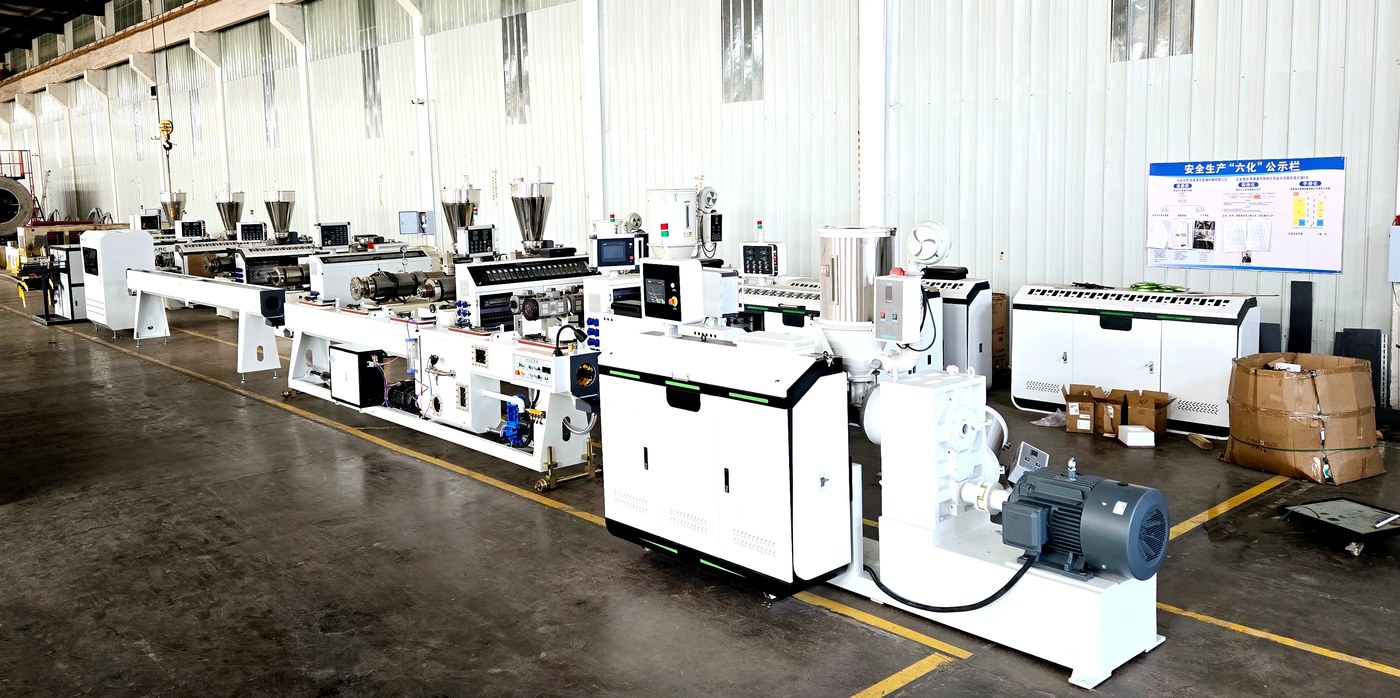
1. PE-RT Material Feeding and Extrusion
PE-RT raw material and color masterbatch are fed into the single screw extruder. The screw and barrel should provide stable plasticizing without overheating the material. Stable melt pressure is the base for uniform pipe wall thickness.
2. Die Forming and Vacuum Calibration
The PE-RT pipe die head forms the melt into the required pipe size. The pipe then enters the vacuum calibration tank, where vacuum and cooling water help control outside diameter and roundness. For small floor heating pipe, calibration stability is critical.
3. Cooling, Haul-off and Printing
After vacuum sizing, the pipe passes through spray cooling. Cooling must match line speed and wall thickness. The haul-off machine pulls the pipe steadily. If speed fluctuates, wall thickness and pipe appearance can be affected. Online printing or marking can be added according to project requirements.
| Process Step | Main Equipment | Quality Point |
|---|---|---|
| Material feeding | Feeding system | Stable material supply and color mixing. |
| Extrusion | Single screw extruder | Stable temperature, melt pressure and output. |
| Pipe forming | PE-RT pipe die head | Uniform melt distribution and wall thickness. |
| Calibration | Vacuum calibration tank | Accurate outside diameter and roundness. |
| Cooling | Spray cooling tank | Enough cooling before traction and coiling. |
| Receiving | Haul-off and coiler | Stable traction and neat coil packaging. |
PE-RT Floor Heating Pipe Running Video
The running video helps buyers review the real line sequence before selecting the process layout.
Related video solution: PE-RT Pipe Production Line Video Solution for Floor Heating Pipe.
4. Coiling and Final Inspection
For floor heating pipe, coiling tension should be stable. If the coiler pulls too hard, pipe shape and coil appearance may suffer. If the coiling is too loose, packaging may be unstable. Final inspection should check pipe surface, diameter, wall thickness, printing and coil quality.
5. Related PE-RT Resources
For equipment selection, read PE-RT Pipe Production Line for Floor Heating Pipe. For product comparison, visit the PE-RT Pipe Production Line category and the main PE-RT Pipe Production Line product page.
Related PE-RT product pages include High Speed Hot Melt Welding PE-RT Pipe Production Line, Low Consumption Cutting PE-RT Pipe Production Line and 20mm Alkali-Resistant PE-RT Pipe Production Line.
FAQ
Why is coiling important for PE-RT floor heating pipe?
Floor heating pipe is usually delivered in coils. Stable coiling improves packaging quality and helps avoid deformation during collection.
What limits PE-RT pipe line speed?
Line speed is limited by extrusion stability, cooling length, haul-off accuracy and coiling quality. Increasing speed without enough cooling can reduce pipe stability.
Can the PE-RT pipe line add printing?
Yes. Online printing or marking can be added according to pipe standard, brand requirement or project identification needs.
Need a PE-RT Pipe Process Layout?
Send Winsoar your PE-RT pipe size, wall thickness, material, output target, coil length and workshop layout. We will recommend a practical floor heating pipe production line process.