Tel : +86-13812850975 E-mail : info@winsoarst.com

 |


| Quantity: | |
|---|---|
Product Overview & Applications
Winsoar PE-RT pipe production line is a complete plastic pipe extrusion solution for floor heating pipe, underfloor heating pipe and hot water pipe production. It is designed for stable plasticizing, accurate pipe sizing, continuous cooling, synchronized traction and neat pipe coiling.
PE-RT pipe is widely used in radiant floor heating systems and building hot water projects. The production line can be configured according to pipe diameter, wall thickness, material grade, pipe color, output target, coil length, voltage and workshop layout.
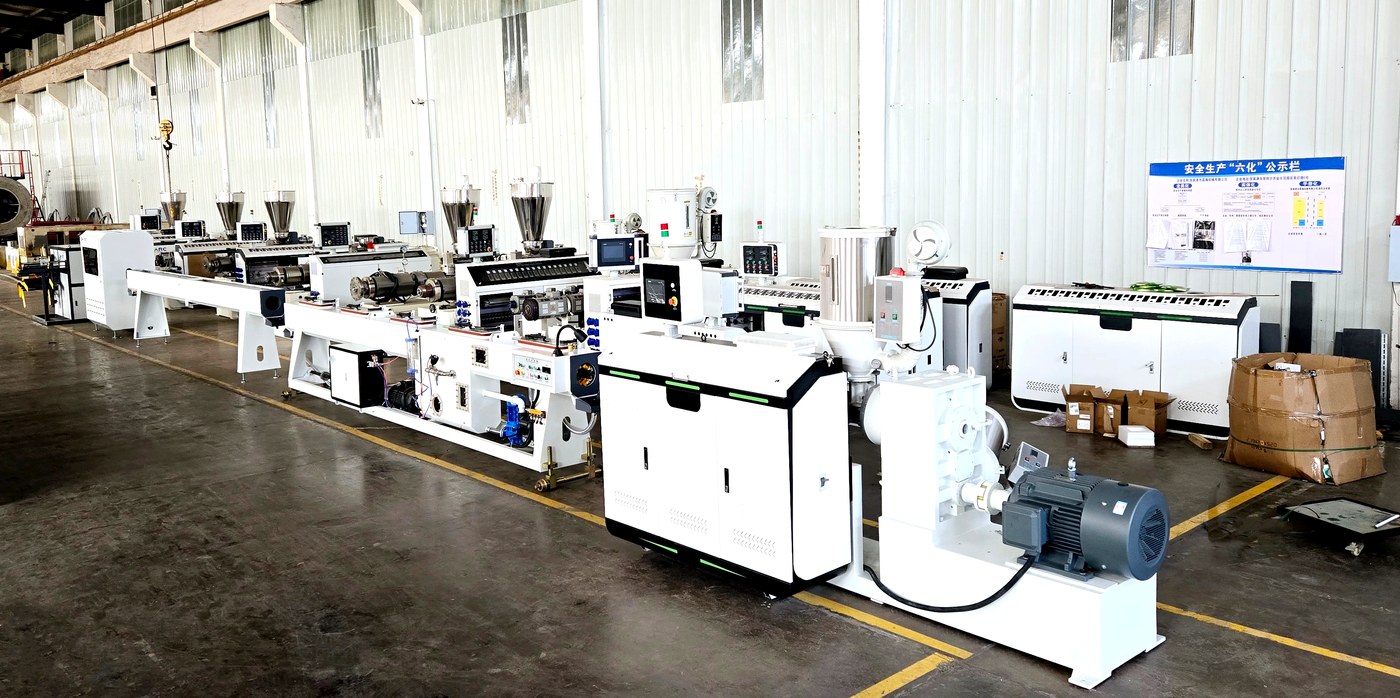
Complete PE-RT Pipe Production Line
This line is suitable for small diameter PE-RT heating pipe and hot water pipe production. Winsoar can adjust the extruder model, die design, cooling length, haul-off structure and coiler specification according to the finished pipe standard.
PE-RT floor heating pipe
Underfloor heating pipe
Hot water pipe
Radiant heating pipe
Red or natural color pipe
Coiled heating pipe production
For a practical PE-RT pipe line proposal, provide target diameter range, wall thickness, pipe application, material grade, output requirement, coil length, cooling water condition, workshop voltage and available installation space.
PE-RT pipe is selected for applications that require flexible installation, stable pressure performance and reliable service under controlled hot-water conditions. A PE-RT extrusion line can produce pipe for underfloor heating, radiant heating, building hot-water distribution, manifold connections and selected plumbing projects. The line must be configured around the pipe standard, temperature class, wall thickness, coil format and output target rather than only the nominal diameter.
PE-RT project | Production focus |
|---|---|
Underfloor and radiant heating pipe | Stable outside diameter, smooth inner surface, accurate wall thickness and flexible coiling. |
Hot-water distribution pipe | Material grade, temperature and pressure requirement, marking and dimensional control. |
Manifold and room-heating connections | Small diameter tooling, repeatable coil length, clean cutting and easy handling. |
Building plumbing and utility tubing | Pipe standard, working temperature, wall thickness, line speed and packing method. |
The practical production range depends on the buyer's main sizes and the required wall thickness. The die head, calibration sleeves, cooling section, haul-off and coiler should be matched to the sizes that will run most often.
16-20mm: commonly used for floor-heating circuits and small connections; precise calibration and stable winding tension are important.
20-25mm: often used for radiant heating and manifold systems; confirm coil diameter, coil length and required marking.
25-32mm: may be used for larger heating loops, hot-water distribution or connection pipe; confirm wall thickness and output.
Multiple diameters: provide the main production size and the complete size list so tooling and changeover requirements can be quoted accurately.
PE-RT resin grade, additive package, color masterbatch and moisture or contamination control affect plasticizing and finished-pipe quality. The single screw extruder should provide stable melt pressure and temperature control for the selected compound. Feeding, screw geometry, die design and cooling must be considered together so that the pipe remains round and the wall thickness stays within the project tolerance.
For hot-water or heating applications, the quotation should state the PE-RT grade, applicable pipe standard, design temperature, pressure class, color and marking requirements. Different compounds can require different processing windows, so a generic output number should not be treated as a guaranteed result for every formula.
Machine section | Role in PE-RT production |
|---|---|
Single screw extruder | Melts and conveys PE-RT resin with controlled temperature, pressure and output. |
Pipe die head and tooling | Forms the tube section and determines the available diameter and wall-thickness range. |
Vacuum calibration tank | Supports outside-diameter control and initial sizing after the die head. |
Spray cooling tank | Removes heat progressively before haul-off and winding or cutting. |
Haul-off machine | Maintains stable traction speed without marking or deforming flexible pipe. |
Chipless cutter | Produces clean fixed-length sections when the project requires straight pipe. |
Pipe coiler | Creates compact coils with controlled tension, diameter, weight and length. |
Color marking unit | Adds identification stripes or lines when required by the product or market. |
Many floor-heating projects use coiled PE-RT pipe because it reduces joints and simplifies installation. The coiler must be selected according to outside diameter, wall thickness, coil outside diameter, coil weight and required length per coil. Excessive winding tension can flatten flexible pipe, while insufficient tension can create loose or unstable coils.
Straight-length production may be preferred for certain hot-water, plumbing or distribution projects. In that case, the cutter, receiving table and pipe handling arrangement should be included. Confirm fixed length, end quality, bundle method and whether both coil and straight-length production are required.
Check outside diameter and wall thickness after calibration and cooling.
Monitor melt pressure and temperature stability during long production runs.
Confirm pipe roundness, surface smoothness and absence of visible lines or deformation.
Verify marking position, color consistency and legibility when a stripe is used.
Check coil diameter, winding tension, coil weight and length per coil.
Record resin grade, production settings and inspection results for traceability.
Choose a PE-RT line when the project is specifically for flexible heating or hot-water pipe and the material's temperature and pressure requirements must be controlled. A PPR line is normally planned for PP-R rigid hot- and cold-water pipe, while a PE or HDPE line is selected for different water, gas, irrigation or conduit applications. The material, product standard and installation method should be confirmed before choosing the extrusion platform.
Buyer input | Why it affects the line |
|---|---|
Pipe diameter and wall thickness | Determines die tooling, calibration sleeves, cooling and practical line speed. |
PE-RT grade and compound | Influences plasticizing, temperature control, pressure and surface quality. |
Application and design temperature | Clarifies whether the project is floor heating, hot water, plumbing or another use. |
Coil or straight-length format | Determines the coiler, cutter, receiving table and packing arrangement. |
Target output and operating voltage | Helps match extruder size, motor, cooling capacity and electrical design. |
Marking and packing requirements | Defines color stripe, printing, coil length, bundle method and export packaging. |
It is used to make PE-RT pipe for underfloor heating, radiant heating, hot-water distribution, manifold connections and related building plumbing applications.
Yes, when the downstream configuration is planned for both formats. The quotation should state coil dimensions, fixed length, cutting requirements and the required receiving or packing equipment.
Output depends on the extruder, resin grade, die tooling, wall thickness, melt temperature, cooling capacity, haul-off speed and final quality target. A confirmed material and product specification is required for a meaningful output estimate.
Send the diameter range, wall thickness, PE-RT grade, application, design temperature, output target, coil or straight-length format, marking, packing, local voltage and workshop conditions.
List the complete diameter and wall-thickness range.
Identify the main product size and the applicable pipe standard.
Provide PE-RT material grade, color and additive information.
State the application, design temperature and pressure requirement.
Confirm target output, preferred line speed and working schedule.
Choose coiled pipe, straight lengths or both, with coil and cut-length details.
Confirm marking, inspection, packing, local voltage, cooling water and workshop space.
With these details, Winsoar can match the extruder, die head, calibration, cooling, haul-off, cutter, coiler and marking equipment to the actual PE-RT heating or hot-water pipe project.
PE-RT pipe is commonly supplied in coils for underfloor and radiant heating because long continuous lengths reduce joints during installation. Other hot-water or building plumbing projects may request straight lengths. The line should therefore be specified from the final installation format, not only from the nominal diameter.
Application | Important quotation input |
|---|---|
Underfloor heating circuit | Confirm diameter, wall thickness, coil length, coil diameter, winding tension and marking. |
Radiant heating system | Confirm PE-RT grade, design temperature, pressure class, color and required flexibility. |
Hot-water distribution | Confirm straight or coiled delivery, pipe standard, fixed length and receiving or packing method. |
The coiler must be matched to outside diameter, wall thickness, coil diameter, coil weight and target length. Excessive winding tension can affect roundness, while loose winding creates unstable coils. The haul-off and coiler should be synchronized with the cooling section so the pipe reaches the winding unit dimensionally stable.
PE-RT resin grade and the required design temperature or pressure class influence the process window and final application. Provide the grade, color, additive or marking requirements and applicable standard. A general output claim should not be used as a substitute for a real diameter and wall-thickness specification.
Confirm the primary heating-pipe size and complete optional size list.
Provide wall thickness, design temperature and pressure requirement.
Choose coils, straight lengths or both before finalizing downstream equipment.
Confirm marking, inspection, packing, voltage and cooling-water conditions.
Winsoar can match the PE-RT extruder, die head, vacuum calibration, spray cooling, haul-off, marking unit, chipless cutter, coiler and receiving equipment to the actual heating-pipe project.
Video & Technical Parameters
Watch the PE-RT pipe production line running video to review extrusion, calibration, cooling, haul-off and coiling operation.
| Item | Reference Configuration |
| Product name | PE-RT Pipe Production Line |
| Typical pipe application | Floor heating pipe, underfloor heating pipe, hot water pipe |
| Applicable material | PE-RT material, customized according to pipe application |
| Extruder | High-efficiency single screw extruder |
| Forming system | PE-RT pipe extrusion die head and calibration sleeve |
| Cooling system | Vacuum calibration tank and spray cooling tank |
| Downstream | Haul-off machine and pipe coiler |
| Customization | Pipe diameter, output, coil length, voltage, color stripe and workshop layout |
For this PE-RT Pipe Production Line, compare the matching PE-RT Pipe Production Line category, related product options and adjacent pipe extrusion categories before confirming configuration.
Use these PE-RT pipe production line resources to compare floor heating pipe machines, underfloor heating pipe extrusion, oxygen barrier pipe layouts and related pipe extrusion categories.
Selection guide:
PE-RT Pipe Production Line for Floor Heating Pipe - PE-RT floor heating pipe line selection, machine configuration and coiling requirements
PE-RT Floor Heating Pipe Production Line Process - PE-RT floor heating pipe process from extrusion, calibration and cooling to haul-off and coiling
PPR vs PE-RT Pipe Production Line: How to Choose - comparison between PPR hot and cold water pipe lines and PE-RT floor heating pipe lines
Running video solution:
PE-RT Pipe Production Line Video Solution for Floor Heating Pipe - running video and layout notes for PE-RT floor heating pipe extrusion and coiling projects
| Product page | Typical project focus |
| High Speed Hot Melt Welding PE-RT Pipe Production Line For Apartments | high speed PE-RT floor heating pipe production for apartment heating projects |
| Low Consumption Cutting PE-RT Pipe Production Line For Business Districts | energy-conscious PE-RT heating pipe extrusion with stable cutting for commercial projects |
| PE-RT Pipe Production Line | standard PE-RT pipe extrusion line for radiant floor heating and hot water pipe production |
| Impact-Resistant Red PE-RT Solar Residential Pipe Extrusion Line | red PE-RT residential heating pipe extrusion for solar and hot water applications |
| 20mm Alkali-Resistant PE-RT Water Supply Pipe Production Line | 20mm PE-RT water supply and floor heating pipe production with small diameter coiling layout |
| Hospital-Custom Red Alkali-Resistant PE-RT Pipe Automatic Production Line | custom red PE-RT heating and hot water pipe extrusion for hospital and building plumbing projects |
Related pipe categories: Plastic Pipe Production Line, PE Pipe Production Line, PVC Pipe Production Line, PPR Pipe Production Line, PE-RT Pipe Production Line.
Machine Configuration
A PE-RT pipe production line usually includes material feeding, single screw extrusion, pipe die forming, vacuum calibration, spray cooling, haul-off, coiling and electrical control. Each section should be matched according to pipe diameter, line speed and finished coil requirement.

The single screw extruder is used for stable PE-RT plasticizing and melt delivery. Screw design, motor power and control system can be selected according to the required output and pipe size.
The pipe die head forms the melt into a stable pipe blank before calibration. The die and sizing sleeve are configured for the required pipe diameter and wall thickness.


The vacuum calibration tank controls pipe outside diameter and roundness after extrusion. Stable vacuum and water temperature help keep PE-RT pipe size consistent.
The spray cooling tank continues pipe cooling after calibration. Cooling length and water circulation are selected according to pipe size, output and line speed.


The haul-off machine keeps synchronized traction and helps maintain steady pipe wall thickness. The traction structure is selected according to pipe diameter and line speed.
The coiler receives finished PE-RT floor heating pipe into rolls. Coil diameter, automatic receiving and winding layout can be matched with the customer's packaging method.

Factory, Packaging & Exhibition
Winsoar supports PE-RT pipe extrusion projects from configuration discussion to manufacturing, workshop testing, packaging, container loading and shipment coordination. Factory and exhibition communication helps buyers confirm practical equipment layout before production.
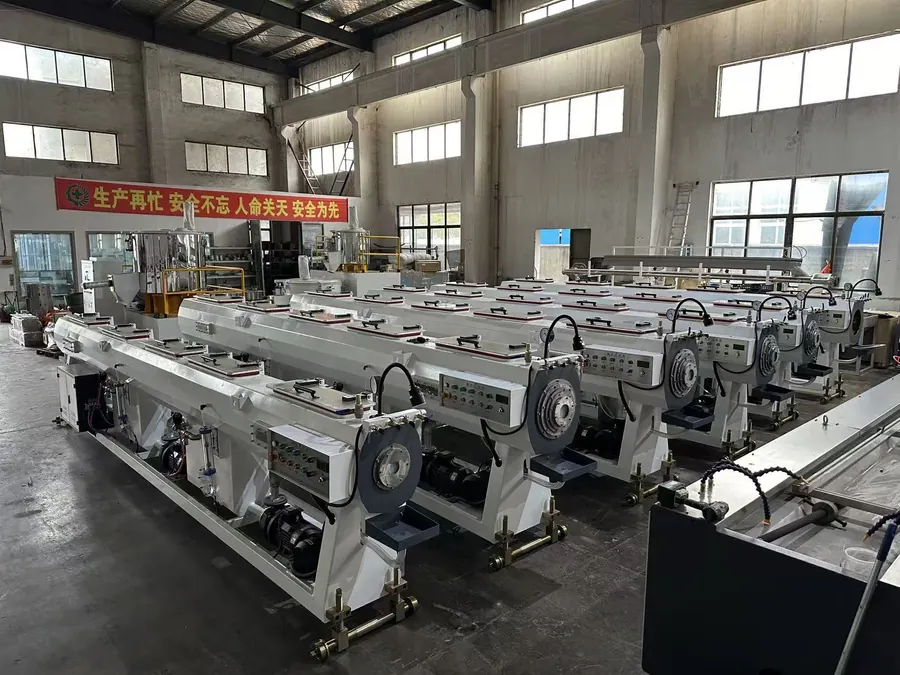
Winsoar manufactures plastic extrusion machines according to confirmed pipe diameter, output requirement, voltage and factory layout. The PE-RT pipe production line configuration can be discussed before production.
Before shipment, machine parts, control cabinet, downstream equipment and auxiliary systems can be checked in the workshop to reduce installation risk.
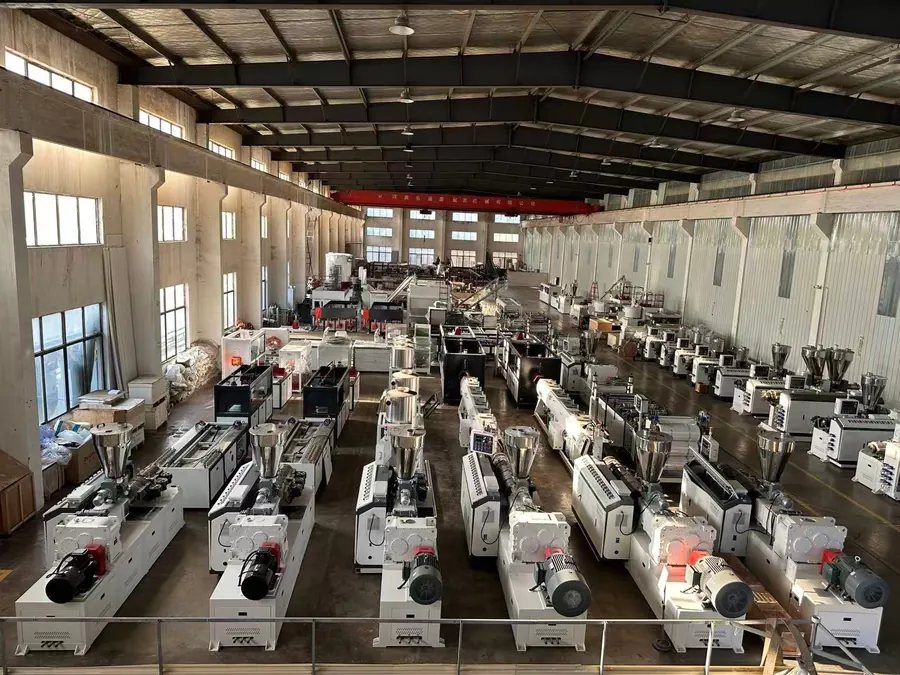
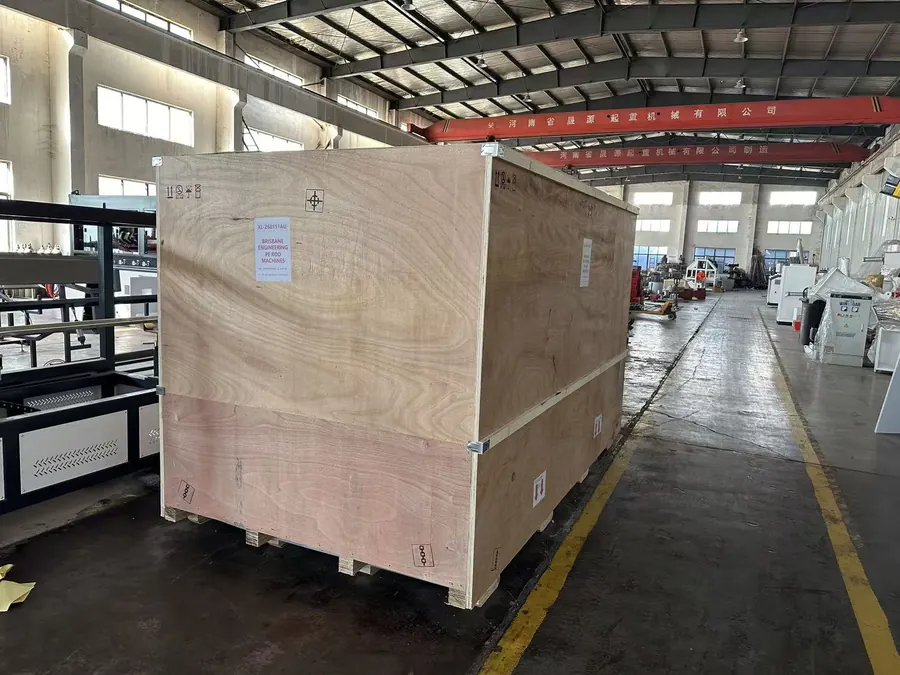
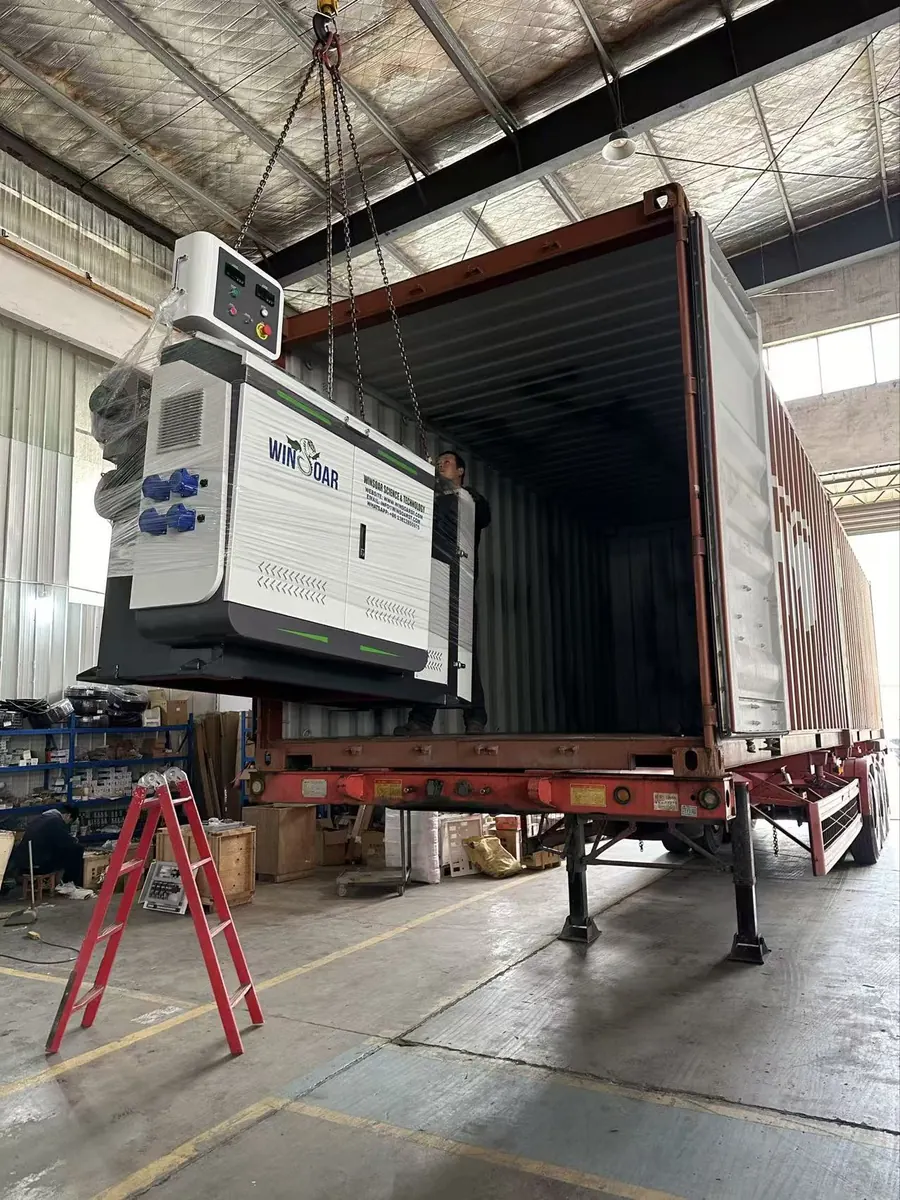
Winsoar prepares export packaging according to machine size and transportation requirements. Protective wrapping and wooden cases help protect die heads, electrical parts and auxiliary equipment.
Container loading photos help buyers confirm shipment preparation and machine delivery status. Winsoar can arrange loading plans according to equipment dimensions and destination requirements.
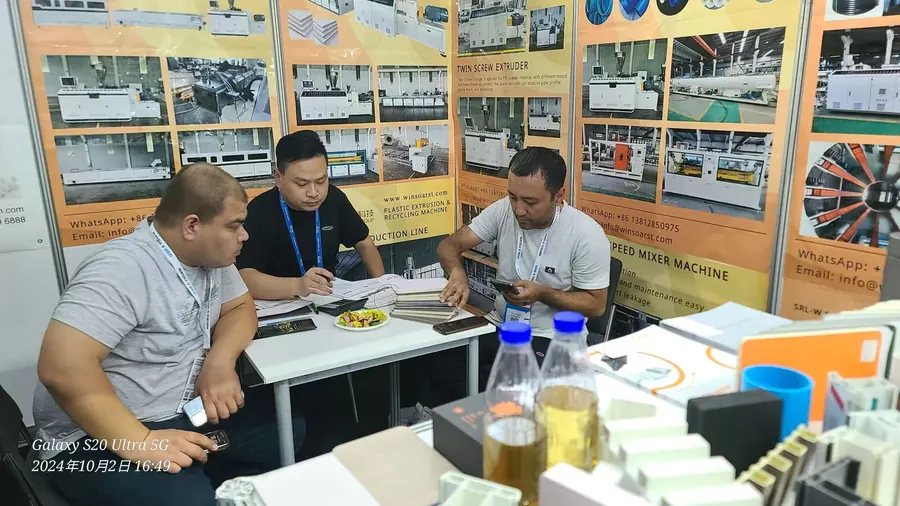
Before quotation, buyers can discuss pipe sample, pipe diameter, wall thickness, local standard, output target and factory layout with Winsoar. These details help us recommend a practical PE-RT pipe extrusion line.
Tell Winsoar your pipe diameter range, wall thickness, heating pipe application, material grade, output requirement, coil length, voltage and workshop layout. We will recommend a suitable PE-RT pipe production line configuration, including extruder, die head, calibration tank, cooling tank, haul-off, coiler, packaging plan and shipment support.