Tel : +86-13812850975 E-mail : info@winsoarst.com

Views: 0 Author: Winsoar Group Publish Time: 2026-11-10 Origin: Site


Key Takeaways
- Tank selection starts with the complete pipe range, wall thickness or SDR, material, line speed and finished-pipe quality requirement.
- The vacuum calibration tank establishes outside diameter and roundness near the die; the spray cooling tank removes heat and stabilizes the pipe downstream.
- Effective tank length depends on heat removal, pipe size, wall thickness, material behavior, water conditions and available line speed. It should be confirmed from project data rather than a generic rule.
- A quotation should state tank function, usable length, diameter range, vacuum and water-control method, utilities, layout and acceptance checks.
In a plastic pipe extrusion line, the vacuum calibration tank and cooling tanks form the section that turns a hot melt tube into a dimensionally stable pipe. The calibration section controls the initial outside diameter and roundness. The cooling section removes heat so the pipe can be pulled, cut, coiled or stacked without losing its shape.
These machines should be matched with the die head, haul-off and downstream cutter as one line section. A tank that looks suitable from its headline diameter may still be wrong if the pipe has a thick wall, the line runs at a different speed, or the receiving equipment needs a hotter or colder pipe condition.
For a new project, begin with the complete product list and the highest-demand operating case. For an existing line, record the die size, actual pipe temperature, water temperature, line speed, vacuum stability and the point where the pipe becomes self-supporting.
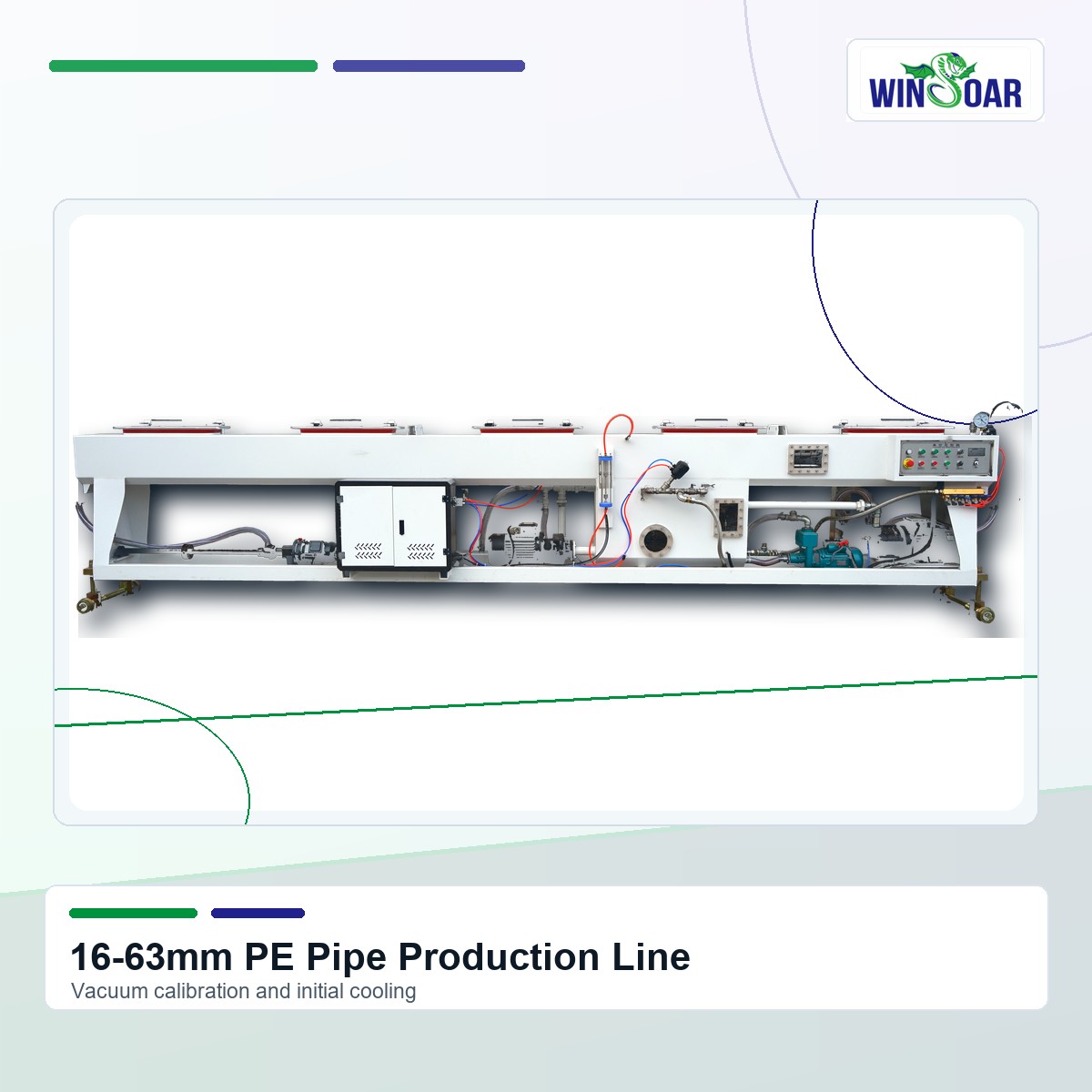
A vacuum calibration tank supports the pipe immediately after the die and uses a sizing sleeve or calibration system to establish the outside diameter. Vacuum draws the softened pipe against the sleeve while controlled water cools the surface. The result is a repeatable starting geometry for the rest of the line.
The exact sleeve, sealing arrangement, vacuum circuit and water path depend on pipe diameter, material, wall thickness and the line design. The tank should therefore be specified with the die head and the target pipe standard, rather than purchased as an isolated cabinet.
The 16-63mm PE pipe production line shows a compact line arrangement that includes a vacuum calibration tank for small-diameter PE pipe. A larger project such as the 200-400mm PE pipe production line needs a different mechanical scale, support arrangement and cooling plan.
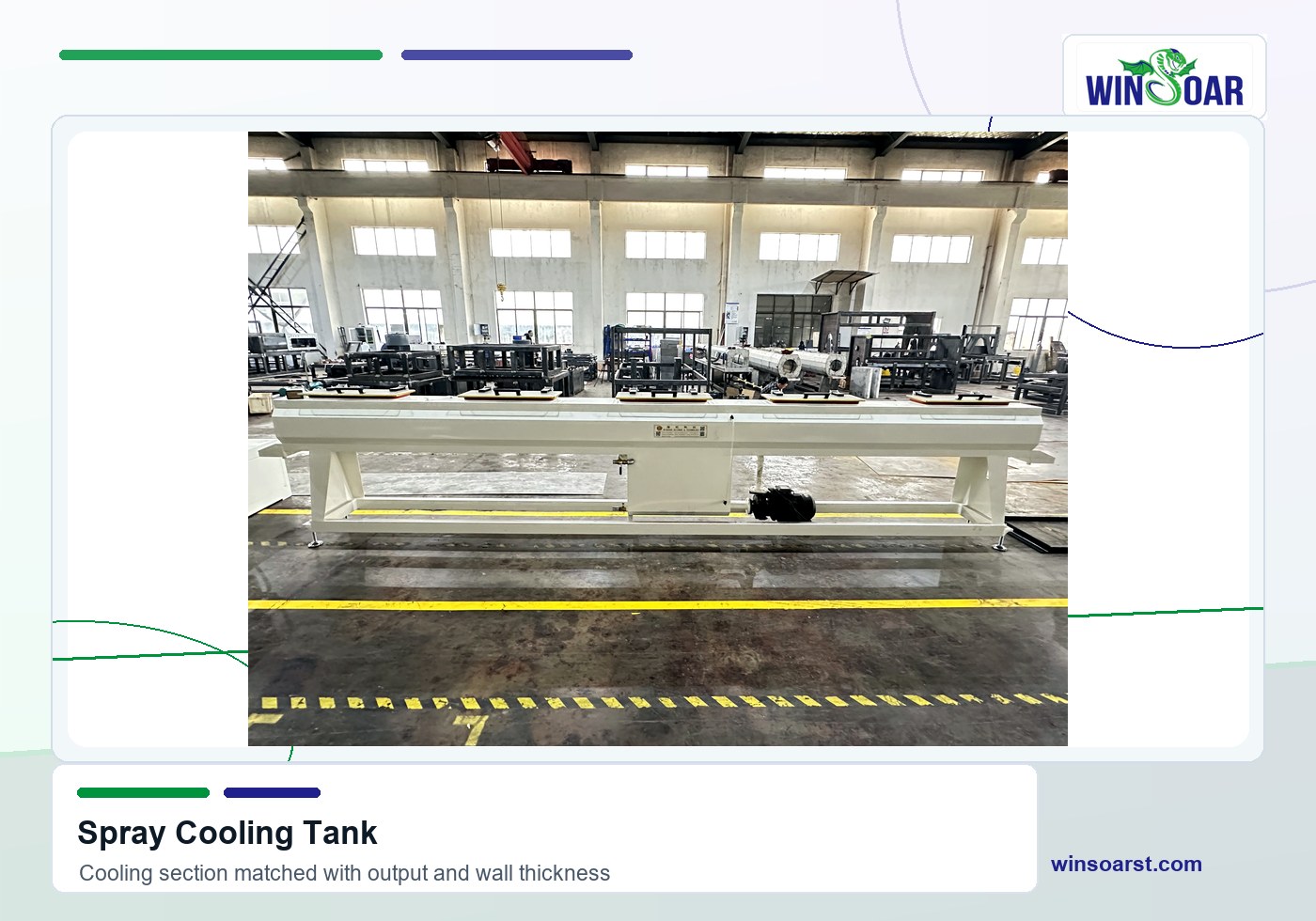
A spray cooling tank continues heat removal after the first sizing and calibration stage. Nozzles distribute cooling water around the pipe while guides and supports keep the pipe aligned. The section gives the pipe time to stabilize before it reaches the haul-off and cutter.
The spray tank is not simply an extension of the vacuum tank. Its job is mainly thermal management and alignment, while the vacuum tank performs the critical early sizing work. The number of spray zones, water circulation, drainage, support spacing and usable length should follow the pipe's heat load and the line speed.
For a project with several pipe sizes, ask the supplier how the spray pattern and guides change between the smallest and largest products. A configuration that is comfortable for a small pipe may not provide enough support or heat removal for a large, thick-wall pipe.
The first sizing question is not just the maximum outside diameter. Collect the complete operating window and identify which products are straight pipe, coiled pipe, pressure pipe, conduit or drainage pipe.
| Input | Why it changes the tank selection | Information to provide |
|---|---|---|
| Outside diameter | Determines sleeve, guide, seal and support dimensions | Minimum, maximum and normal production diameters |
| Wall thickness or SDR | Changes the heat that must be removed before traction | Wall thickness, SDR or pipe standard for each size |
| Material | Affects melt behavior, shrinkage and cooling response | PE80, PE100, HDPE compound, PVC, PPR or another grade |
| Line speed | Sets the time available for calibration and cooling | Start-up, normal and maximum speed |
| Product form | Changes downstream support and receiving needs | Straight length, coil, stacker, belling or manual handling |
| Surface and marking | Affects guide contact and inspection | Marking position, surface sensitivity and appearance standard |
| Utilities | Determines water and vacuum circuit design | Water temperature, flow, filtration, drainage and power |
| Workshop layout | Limits tank length, access and downstream direction | Available line length, lifting path and service clearance |
Use the normal production case for the main comparison, then check the highest heat-load product. If a line covers a wide range, a single tank may require interchangeable sleeves, adjustable guides or a longer usable section. The quotation should state those changeover requirements.
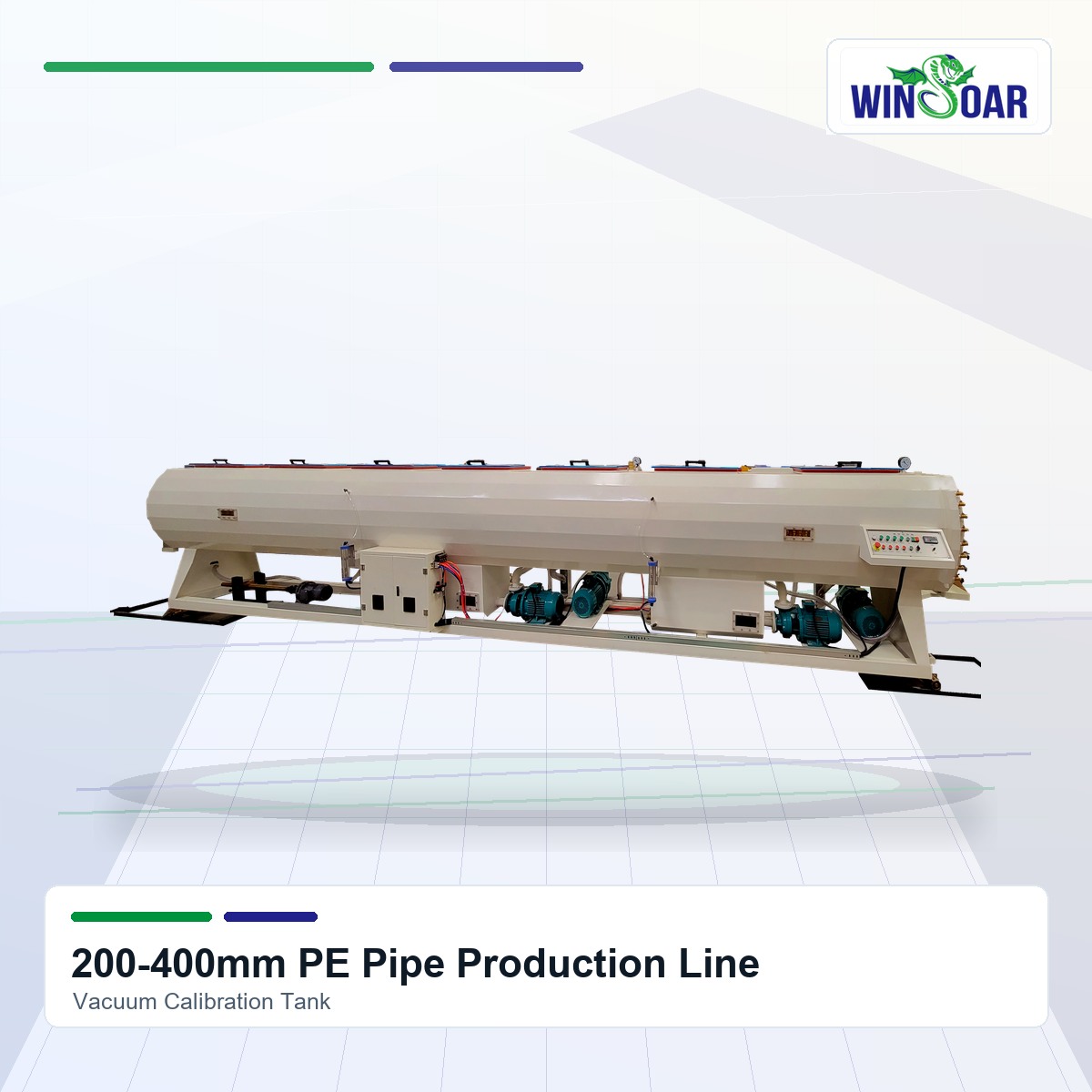
Tank length is the distance available for sizing, heat transfer and pipe stabilization. The required length increases when the pipe wall is thicker, the material retains more heat, the line runs faster or the process needs the pipe to be stable before traction and cutting.
There is no universal length that fits every diameter range. A supplier should evaluate the die output, pipe surface temperature, water temperature, spray coverage, support spacing and target speed together. Ask for the usable process length, not only the outside cabinet length.
When comparing two quotations, check whether the stated length includes the inlet sealing area, transition section, inspection space and outlet guide. These areas may be useful for the layout but do not all provide the same effective cooling or calibration function.
For large-diameter PE pipe, the tank may also need stronger guides, more stable water circulation and a longer transition before the haul-off. The 200-400mm PE line configuration lists vacuum and spray cooling as separate machine functions, which is a useful way to review the full line rather than treating cooling as one generic box.
Vacuum should be stable enough to hold the pipe against the calibration sleeve without creating an unstable wall or surface marks. The required control range depends on the sleeve, pipe size, material, melt temperature and sealing condition.
Ask the supplier to explain:
Do not turn a single vacuum number into a universal specification. The useful requirement is a stable, adjustable process that can be validated against outside diameter, roundness and surface quality for the selected pipe range.
Cooling performance depends on water temperature, flow, spray coverage, filtration, drainage and the contact time available in the tank. Clean water distribution matters because blocked or uneven nozzles can create local temperature differences and affect pipe roundness.
Confirm whether the quotation includes a circulation pump, filter, temperature display, flow adjustment, drain connection and access for nozzle cleaning. For multiple diameters, check if the spray arrangement can be adjusted without moving the complete tank.
Water conditions should be stated as project inputs. Local supply temperature, cooling-tower capacity and seasonal changes can affect the result, so a supplier should avoid promising a fixed output or speed without confirming the buyer's utilities.
The pipe should leave the cooling section centered and sufficiently stable for the haul-off to pull it without introducing a bend or surface mark. Guides, support rollers and the tank outlet should align with the die centerline and the downstream machine centerline.
Review the complete handoff:
The pipe haul-off selection guide explains why traction should be evaluated with pipe range, line speed and contact length. Cooling and alignment affect that traction section directly; a stable pipe is easier to pull and measure consistently.
PE and HDPE lines require controlled sizing and gradual heat removal, especially when the project includes pressure pipe or thick-wall products. Confirm PE grade, SDR, die output, target diameter tolerance and whether the line produces straight lengths or coils. The HDPE pipe extrusion line selection guide can be used with the tank data when comparing complete line configurations.
PVC pipe projects often place strong emphasis on outside diameter, roundness, surface appearance and downstream socket or belling operations. Confirm the pipe standard, wall thickness, belling blank length and the temperature condition required before the cutter or belling machine. Keep the cooling specification tied to the actual PVC formulation and die output.
For PPR and other thermoplastics, specify the formulation, color or layer structure, diameter range, wall thickness and surface requirement. A multi-layer or co-extruded pipe may need a different temperature and alignment review from a single-layer product. The supplier should confirm the cooling and calibration sequence from the complete process data.
Review the table in this order:
The PE pipe production line category helps compare different diameter ranges. Use it as a starting point, then request the detailed calibration sleeve, tank length and utility data for the selected line.
Send a line data sheet with:
This information lets the supplier separate fixed machine construction from project-dependent settings. It also makes quotations easier to compare because tank length, usable process length, utility scope and downstream interfaces are visible.
No. A longer cabinet does not automatically provide more useful cooling or better calibration. Compare effective process length, water coverage, support layout, line speed, pipe wall thickness and the available workshop space.
The vacuum calibration tank performs the early sizing and diameter-control function while cooling the pipe surface. The spray cooling tank continues heat removal and supports stabilization before the haul-off and cutting or receiving equipment.
Provide the full diameter range, normal sizes, wall thickness or SDR, material and speed. Confirm interchangeable sleeves, adjustable guides, spray coverage, support spacing and the changeover procedure for the smallest and largest products.
Yes. Material, formulation, melt temperature, wall thickness and line speed all affect heat removal and stabilization. The final length should be confirmed from the process data and acceptance requirements.
Test the complete operating window: vacuum stability, water temperature and flow, outside diameter, roundness, wall-thickness result, surface condition, line-speed changes, haul-off stability and the handoff to the cutter, coiler, stacker or belling machine.
Before approving a pipe extrusion line cooling section, confirm the pipe range, wall thickness or SDR, material, die output, speed, usable tank length, calibration sleeve, vacuum-control method, water zones, spray coverage, filtration, drainage, guides, centerline, utilities, workshop layout and downstream handoff.
The right tank is the one that keeps diameter and roundness stable across the intended operating range while removing enough heat for reliable traction and finishing. A complete project data sheet is the best protection against an undersized tank, an unusable layout or a quotation that hides the real utility and changeover requirements.