Tel : +86-13812850975 E-mail : info@winsoarst.com

 |


| Quantity: | |
|---|---|
200-400mm PE Pipe Production Line
Winsoar
WSP-PE-200-400
Product Overview & Applications
Winsoar 200-400mm PE Pipe Production Line is a medium-to-large diameter HDPE pipe extrusion line for straight PE pipe production in water supply, gas distribution, irrigation, drainage, cable duct and industrial pipe projects.
Direct answer: A 200-400mm PE Pipe Production Line is a complete HDPE pipe extrusion line for medium-diameter straight pipe production. It typically includes single screw extrusion, optional color marking co-extrusion, PE pipe die head, vacuum calibration, spray cooling, haul-off, chipless cutting, with downstream pipe receiving configured separately by pipe length and workshop layout.
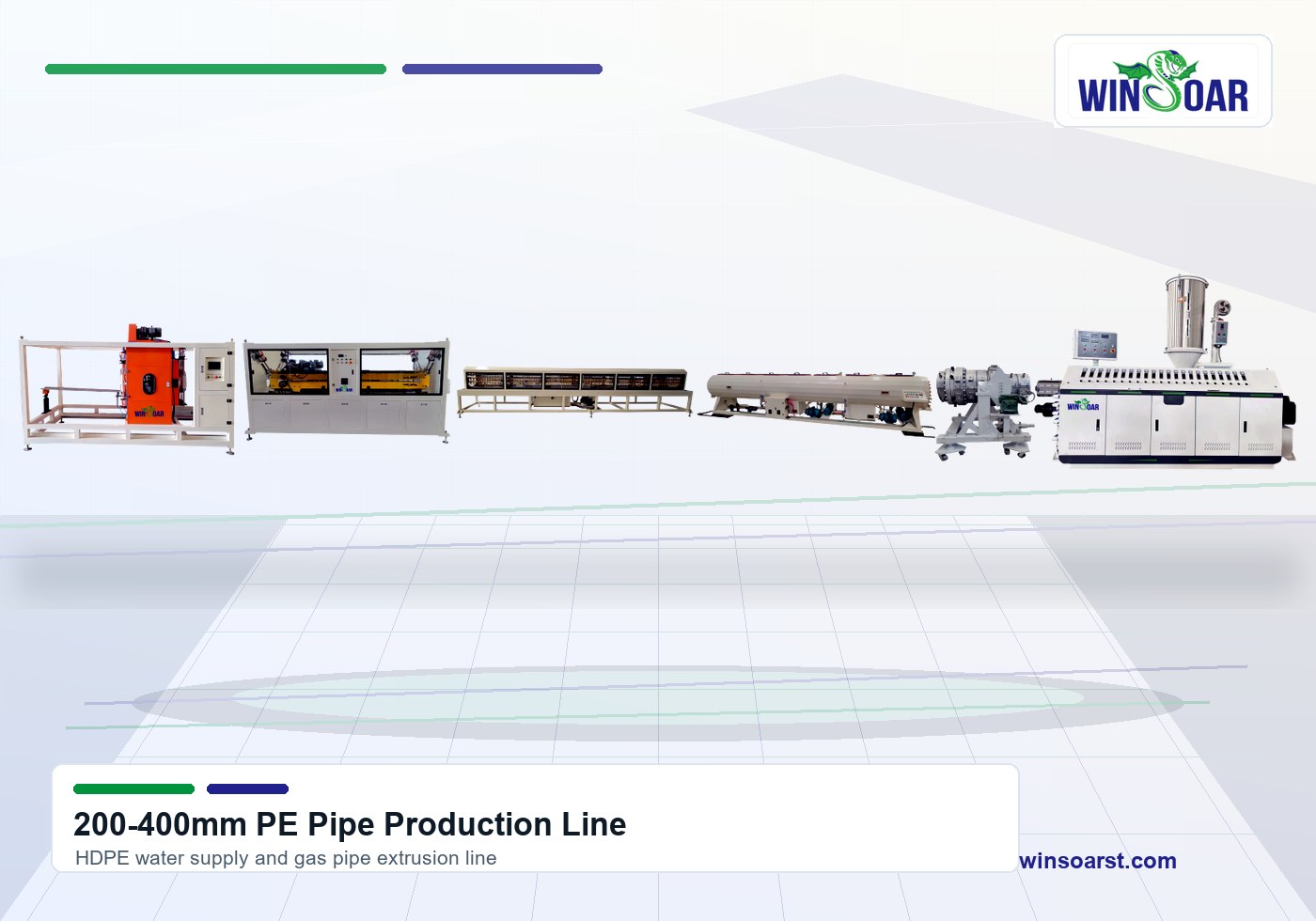
Medium-to-Large HDPE Pipe Line for Municipal Water and Gas Projects
The 200-400mm range is commonly selected for municipal water supply, gas distribution, industrial pressure pipe and main irrigation pipe projects. The line layout should reserve enough cooling distance, stable traction and clean fixed-length cutting for heavier straight pipes.
Pipe range: 200-400mm, project-based configuration
Material: PE80, PE100, HDPE and polyethylene compounds
Output focus: pipe roundness, cooling stability and fixed-length chipless cutting
Application | Typical Planning Focus | Key Configuration Point |
Municipal PE water supply pipe | Pressure pipe, SDR control, pipe roundness | Stable die head, vacuum calibration and sufficient cooling |
PE gas distribution pipe | Yellow mark line, pipe surface, size consistency | Color marking co-extruder and synchronized haul-off |
Agricultural irrigation main pipe | Cost-effective output and straight pipe handling | High-efficiency extrusion, stable cooling and chipless cutting |
Cable protection duct | Surface quality, length cutting, stacking | Cooling tank, haul-off, chipless cutter and downstream receiving layout |
Industrial PE drainage pipe | Diameter stability and production continuity | Extrusion output matched with cooling and downstream speed |
Product name | 200-400mm PE Pipe Production Line |
Line type | Medium diameter PE pipe production line / HDPE pipe extrusion line |
Applicable material | PE80, PE100, HDPE and polyethylene compounds |
Pipe diameter range | 200-400mm, customized according to project |
Typical finished pipe | Straight PE / HDPE pipe with fixed length chipless cutting |
Main equipment | Single screw extruder, color marking co-extruder, die head, vacuum tank, spray cooling tank, haul-off and chipless cutter |
Customization | Pipe SDR, wall thickness, output, voltage, cooling length, cutter type, downstream receiving layout and control system |
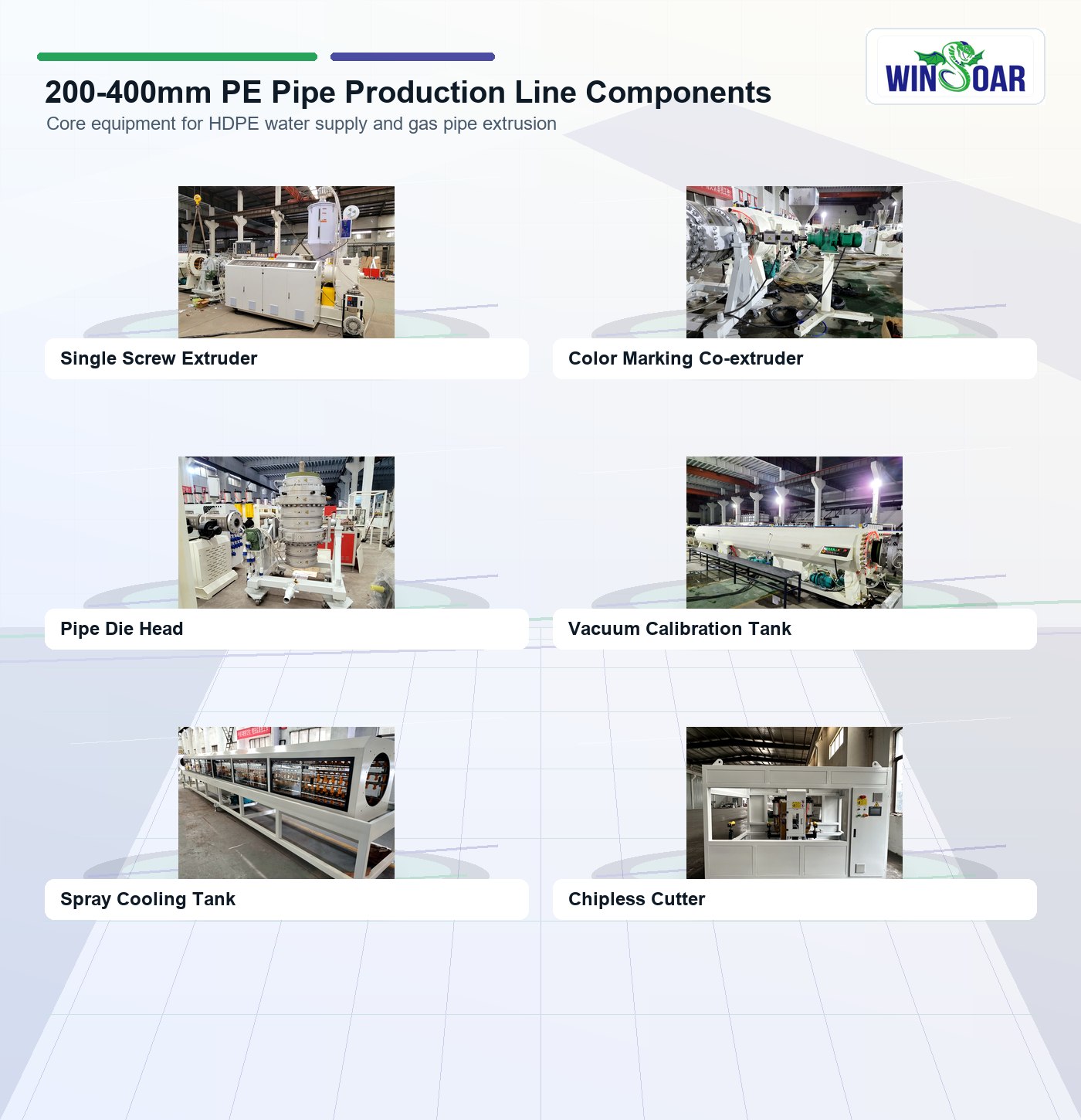
Core Machines for 200-400mm PE pipe Extrusion
The 200-400mm range is intended for medium-to-large straight PE and HDPE pipes, not small coiled pipe production. Buyers normally select this range for municipal water mains, gas distribution, irrigation mains, drainage, cable duct and industrial polyethylene pipelines. Because the finished pipe is heavier and the cooling demand is higher than for small-diameter pipe, the line must be matched as a complete system rather than selected by extruder size alone.
Project requirement | What the 200-400mm configuration must solve |
|---|---|
Water or gas pressure pipe | Stable melt output, accurate outside diameter, SDR or wall-thickness control and optional color marking. |
Irrigation main pipe | Continuous production, suitable pipe length, reliable cooling and downstream receiving space. |
Drainage or cable duct pipe | Production continuity, dimensional stability and a cutter or receiving layout matched to the finished length. |
Industrial PE pipeline | Material grade, output target, pressure requirement and workshop layout confirmed before die selection. |
Within the 200-400mm range, the most frequently produced diameter, wall thickness and required output determine the practical configuration. A project focused on 200-250mm pipe may prioritize flexible die coverage and changeover efficiency. A project focused on 315-400mm pipe normally needs greater cooling length, stronger traction and enough space for fixed-length pipe receiving.
200-250mm: suitable for medium-diameter water, irrigation, drainage and cable protection projects when the target output and SDR are confirmed.
315mm: commonly used as a municipal, irrigation or industrial main-pipe size and requires stable sizing, cooling and haul-off.
355-400mm: requires a configuration planned around heavier straight pipe, longer cooling and safe pipe handling after cutting.
Multiple sizes: confirm the main production size first, then check die, calibration sleeve, cooling length and changeover requirements for the full range.
The existing parameter matrix includes classical 33D and high-efficiency 38D options. The 33D series can be a practical choice when the project prioritizes a proven configuration and the required output is moderate. The 38D series is considered when the buyer needs higher output, more process capacity or stronger production efficiency. The final choice depends on PE grade, SDR, wall thickness, target kg/h, line speed, local power and workshop conditions.
For quotation, do not send only “200-400mm.” Confirm the main pipe size, wall thickness or SDR, PE80 or PE100 material, target output, fixed pipe length, color mark line, local voltage and available line length. These inputs determine whether the WS-450 I, WS-450 II or another configuration is the better starting point.
Pipe diameter range and the most frequently produced diameter.
SDR, wall thickness or pressure-class requirement.
PE grade, material source and whether a color mark line is required.
Target output in kg/h or target production speed.
Fixed pipe length and the preferred chipless cutting method.
Local voltage, cooling-water conditions and workshop length or layout.
Required downstream receiving, stacking or handling method.
With these details, Winsoar can match the extruder, die head, vacuum calibration tank, spray cooling, haul-off, chipless cutter and receiving arrangement to the actual project instead of supplying a generic diameter-range list.
At 200-400mm, a PE pipe line is a heavy-duty production and handling system. The commercial specification should state the main sizes, maximum wall thickness, SDR or pressure class, target output and pipe length. These values affect the extruder, die head, vacuum calibration, spray cooling, haul-off force, cutter and stacking arrangement.
Target size | Key engineering question |
|---|---|
200-250mm | Can the cooling and haul-off maintain roundness at the required line speed and wall thickness? |
250-315mm | What output and fixed length are required, and how will the pipe leave the cutter? |
315-400mm | What is the pipe weight, stacking method, lifting route and available workshop space? |
Large pipe remains hot and heavy after forming. Long vacuum calibration and spray-cooling sections stabilize the outside diameter before the haul-off. The traction system must provide uniform force without surface damage, while the cutter must handle the selected diameter and wall thickness with a clean cut. For thick-wall or long-length pipe, receiving rollers and a planned stacking zone are part of the production solution rather than optional decoration.
PE80, PE100 or other resin grade and the required color or marking.
Nominal diameter, wall thickness or SDR and applicable pipe standard.
Target output at the main size and preferred line speed.
Fixed pipe length, cutter type, end treatment and bundle method.
Cooling-water temperature, workshop length, power supply and lifting equipment.
For municipal or industrial projects, the production line should be quoted from the final pipe specification backward. This avoids using a small-pipe configuration for a large-diameter product and gives the buyer a clearer basis for output, workshop and investment planning.
Video & Technical Parameters
The video shows the 200-400mm PE line structure, while the parameter table helps buyers compare the full PE / HDPE model range before confirming a project configuration.
Watch this 200-400mm PE Pipe Production Line video on YouTube.
| Production line | Diameter range (mm) | Extruder type | Max. capacity (kg/h) | Max. haul-off speed (m/min) | Extrusion power (kW) |
| WS-63 I | 20-63 | SJ65/33 | 220 | 12 | 55 |
| WS-110 I | 20-110 | SJ65/33 | 220 | 12 | 55 |
| WS-160 I | 50-160 | SJ75/33 | 400 | 10 | 110 |
| WS-250 I | 90-250 | SJ90/33 | 400 | 6 | 110 |
| WS-450 I | 160-450 | SJ120/33 | 500 | 4 | 160 |
| WS-630 I | 400-630 | SJ120/33 | 850 | 2 | 280 |
| WS-800 II | 500-800 | SJ120/33 | 850 | 2 | 280 |
| WS-630 I | 315-630 | SJ120/33 | 850 | 2 | 355 |
| WS-800 I | 500-800 | SJ150/33 | 1100 | 1 | 400 |
| Production line | Diameter range (mm) | Extruder type | Max. capacity (kg/h) | Max. haul-off speed (m/min) | Extrusion power (kW) |
| WS-63 II | 20-63 | WSD60/38 | 320 | 30 | 70 |
| WS-110 II | 20-110 | WSD60/38 | 380 | 20 | 90 |
| WS-160 II | 40-160 | WSD60/38 | 460 | 15 | 110 |
| WS-250 II | 50-250 | WSD75/38 | 600 | 12 | 160 |
| WS-450 II | 110-450 | WSD90/38 | 850 | 8 | 250 |
| WS-630 II | 250-630 | WSD90/38 | 1050 | 4 | 280 |
| WS-800 II | 500-800 | WSD120/38 | 1300 | 2 | 355 |
| WS-1200 II | 710-1200 | WSD75/38 + WSD90/38 | 1450 | 1 | 160/250 |
| WS-1600 II | 1000-1600 | WSD90/38 + WSD90/38 | 1900 | 0.6 | 280/280 |
| Decision point | Practical guidance |
| WS-450 range | For 200-400mm projects, WS-450 I or WS-450 II is usually the practical selection because the range covers 200mm, 315mm and 400mm pipes. |
| 33D or 38D | 33D is a classical configuration. 38D is selected when higher output, faster line speed or stronger plasticizing efficiency is required. |
| Cooling length | 200-400mm PE pipes need longer and more stable cooling before traction and cutting, especially for thick SDR pressure pipe. |
| Cutting and downstream receiving | This page is planned for chipless fixed-length cutting. Downstream pipe receiving or unloading is configured separately according to pipe length and workshop layout. |
| Quotation data | Send diameter range, SDR or wall thickness, pipe application, output target, mark-line requirement, fixed length and workshop layout. |
Before checking the final quotation, you can review the matching running video solution for this 200-400mm PE Pipe Production Line. See the 200-400mm PE / HDPE pipe line running test for water supply, gas, drainage and industrial pipe projects.
Machine Configuration
A 200-400mm PE pipe line needs balanced extrusion, sizing, cooling, traction and chipless cutting. Each machine below is described as an independent function so buyers can evaluate the line configuration clearly.
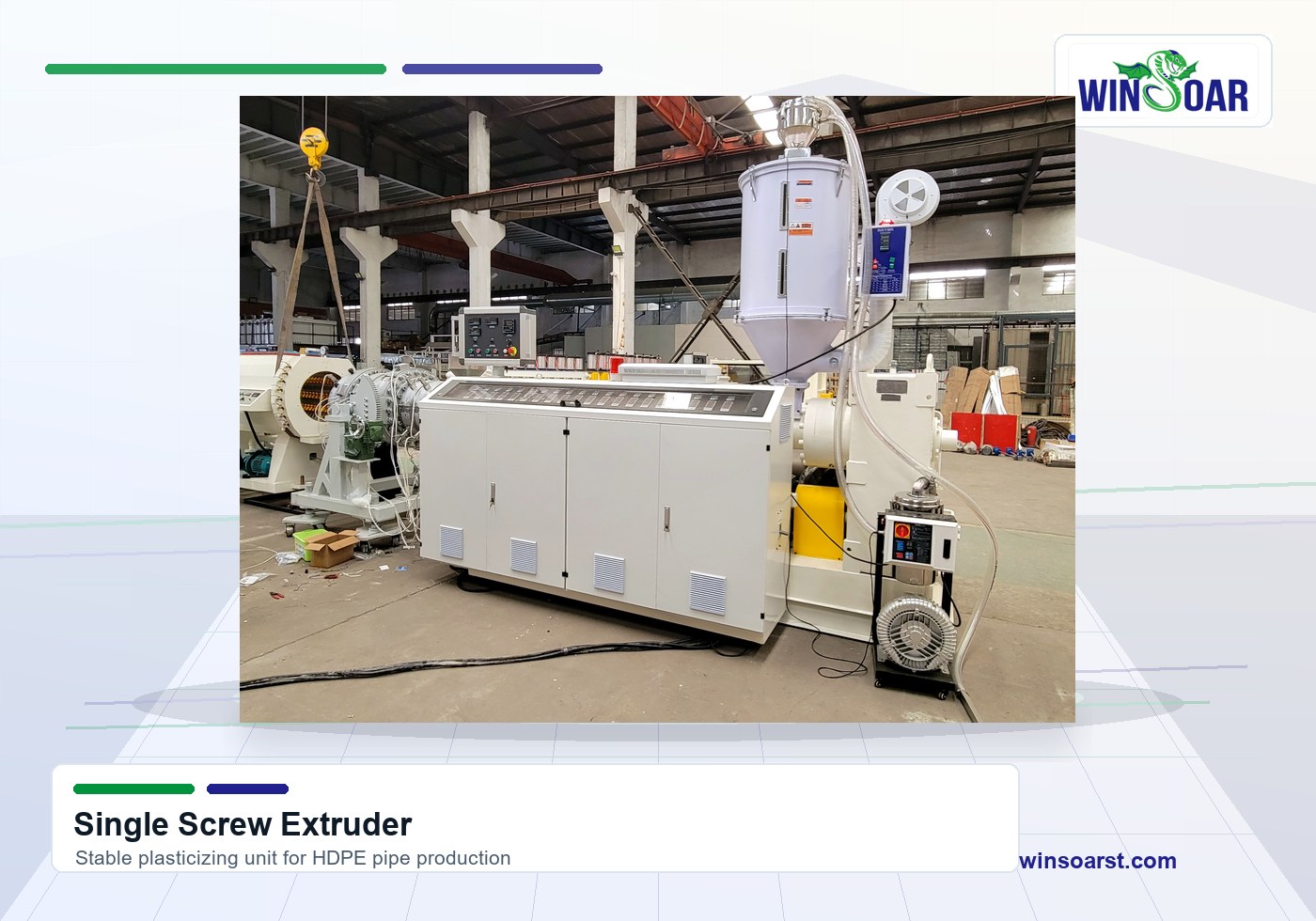
The single screw extruder provides stable PE / HDPE melt output for medium-diameter straight pipe production. Screw, motor power and control system are selected according to SDR, output target and material grade.
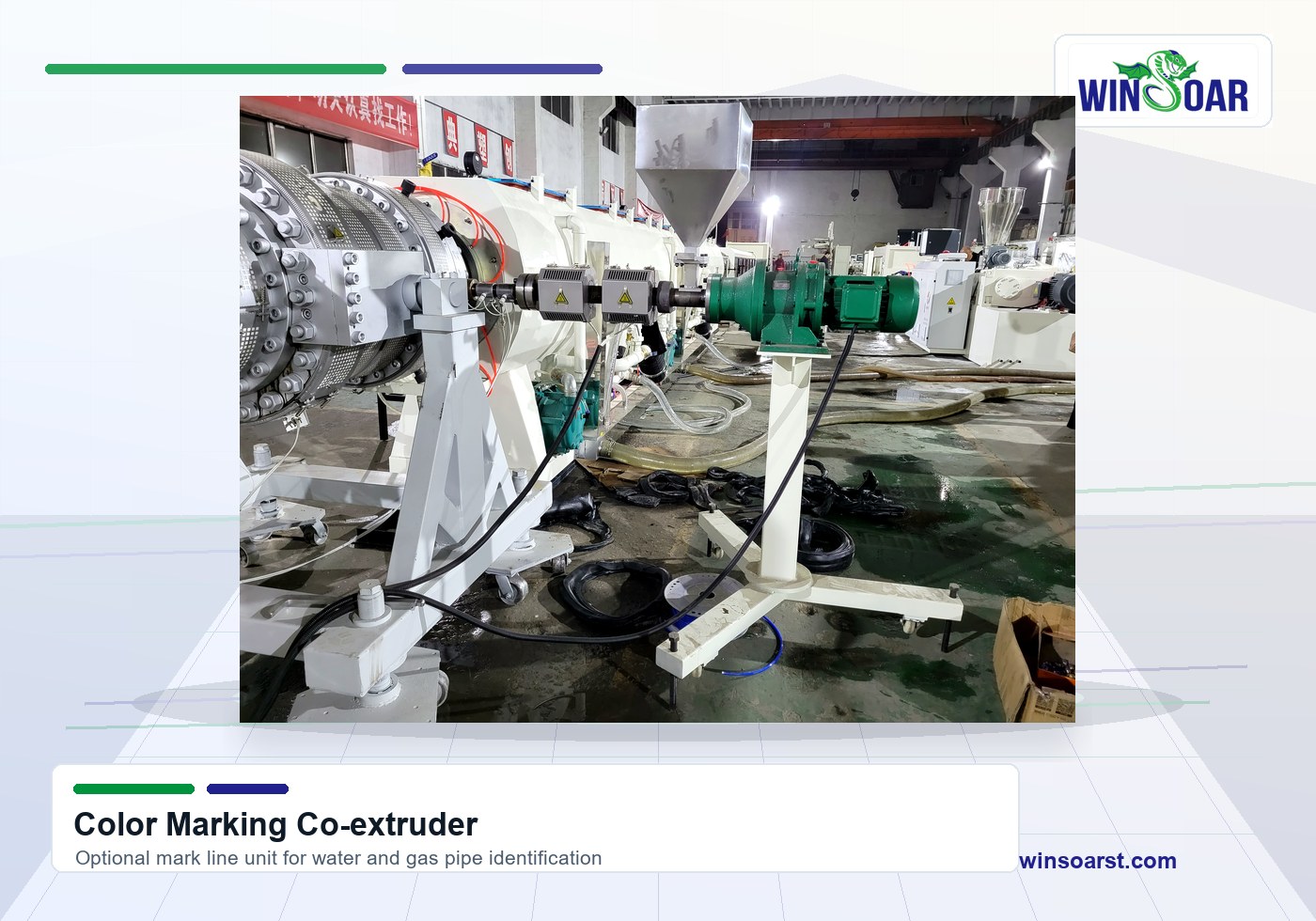
The color marking co-extruder adds blue, yellow or customized stripes when the pipe standard or project identification requires a mark line.
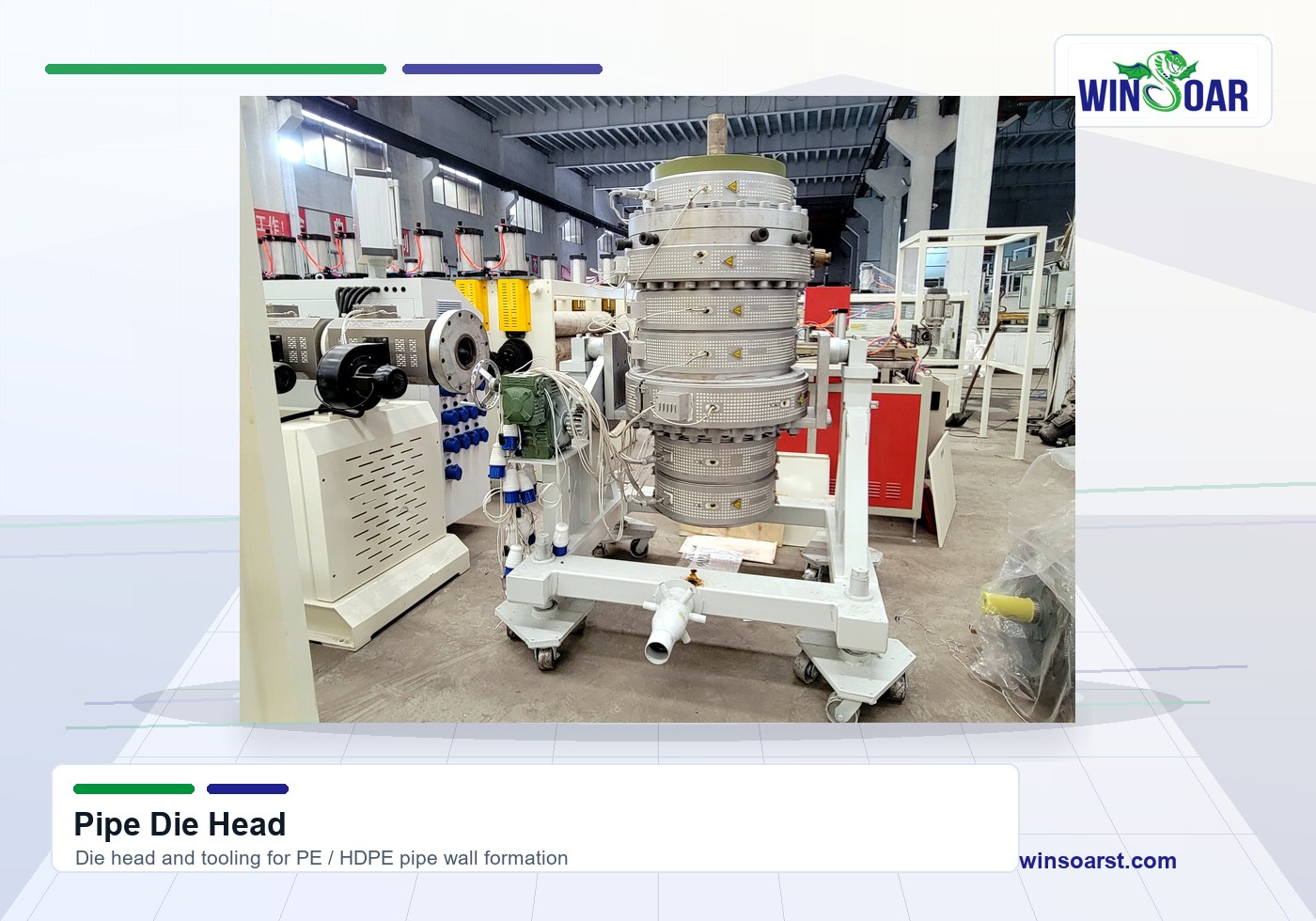
The pipe die head distributes PE melt and forms the pipe wall. For 200-400mm production, die head design affects wall thickness uniformity, pipe surface and mark-line stability.
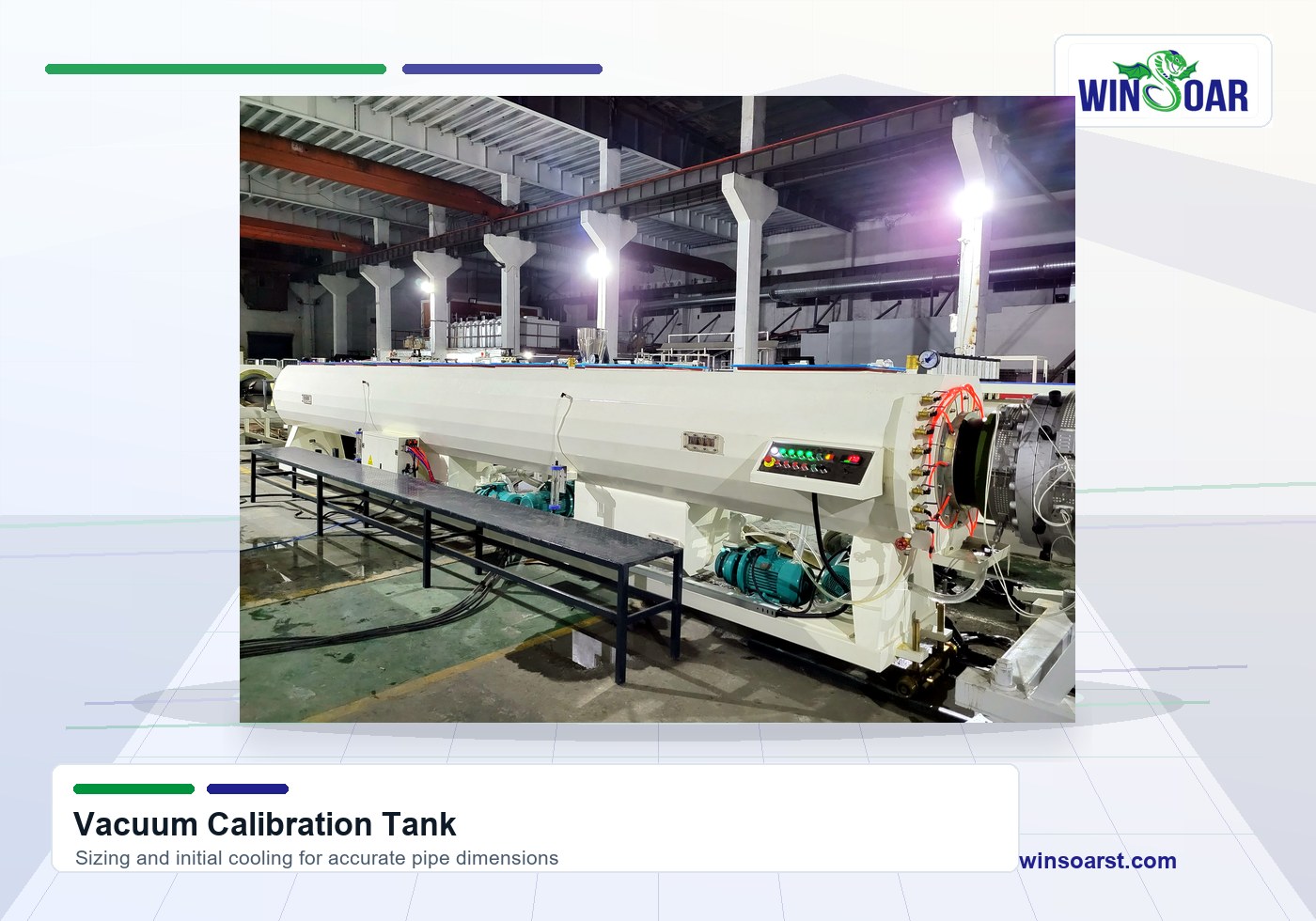
The vacuum calibration tank controls outside diameter and initial pipe cooling. Medium-diameter PE pipe needs stable vacuum, water level and calibration sleeve matching.
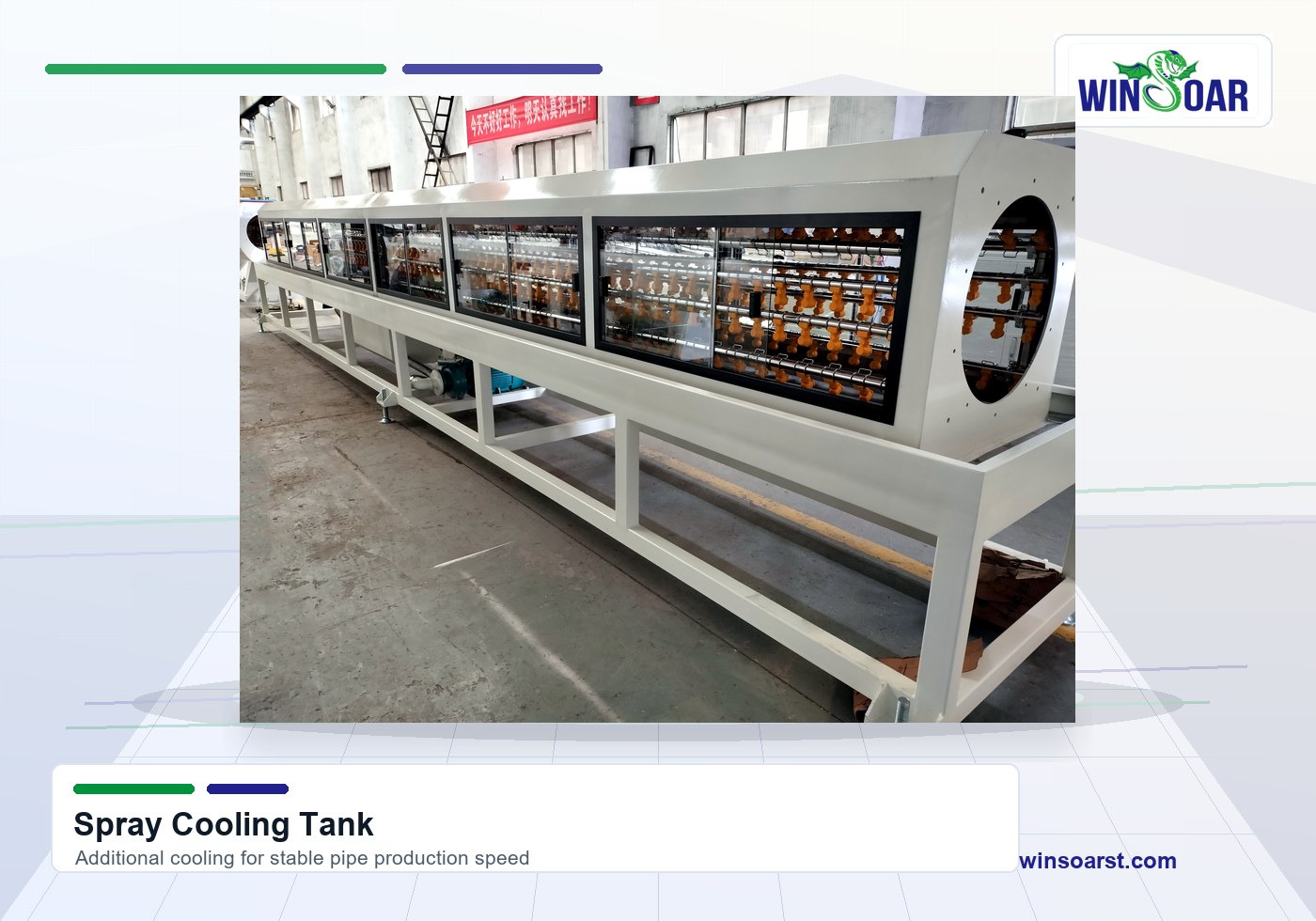
The spray cooling tank continues pipe cooling before haul-off and cutting. For 200-400mm pipe, cooling capacity must match line speed and pipe wall thickness.
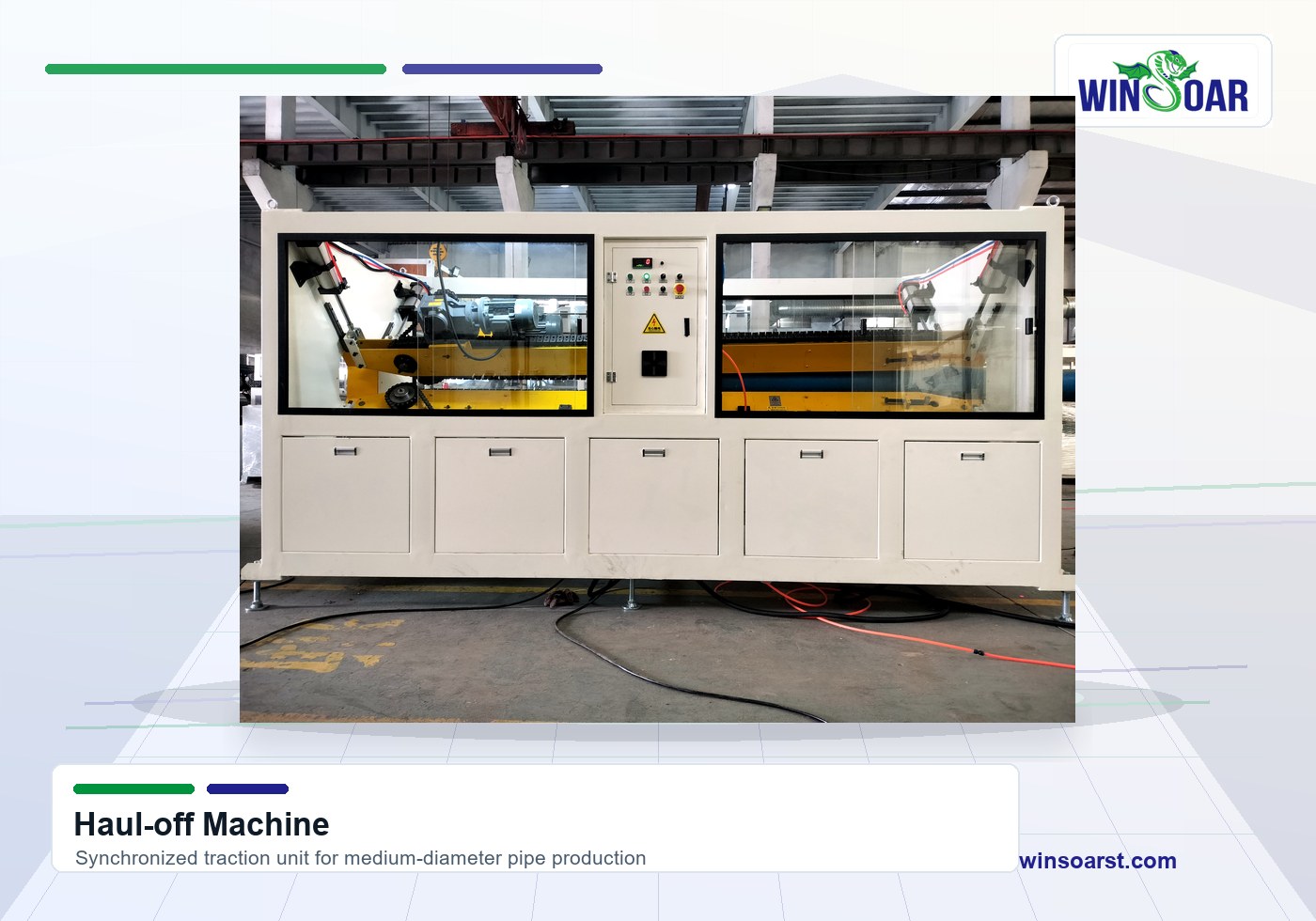
The haul-off machine pulls the pipe at synchronized speed. Stable traction is essential for wall thickness, cutting accuracy and stable fixed-length cutting and downstream pipe receiving.
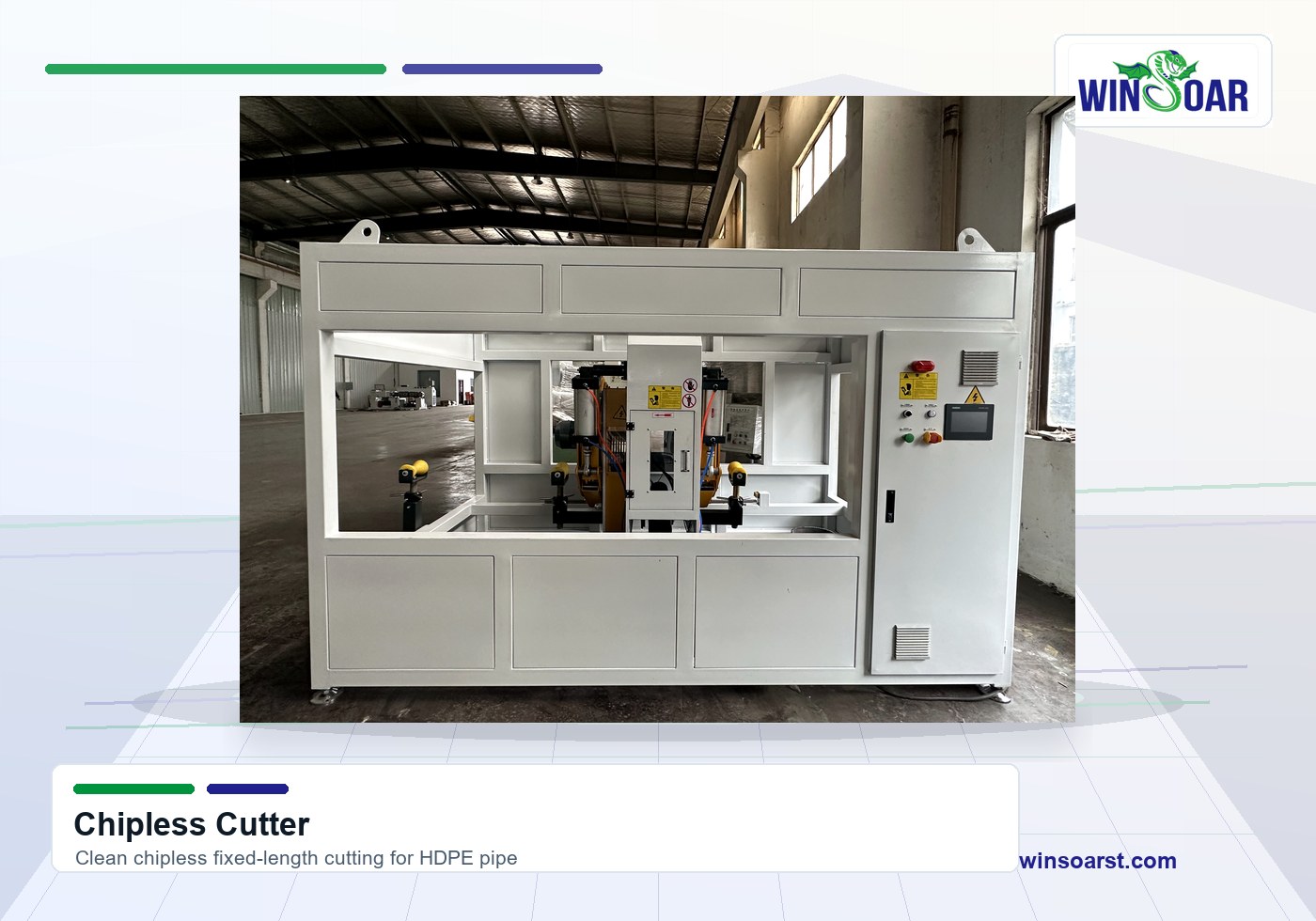
The chipless cutter provides fixed-length cutting for 200-400mm PE pipe without mixing chips into the working area. Cutting is an independent function and should be selected according to pipe diameter, wall thickness and line speed.
| Item to confirm | Why it affects the 200-400mm line |
| Pipe diameter range | Confirms whether WS-450 I or WS-450 II should be used and whether future expansion above 400mm is required. |
| SDR / wall thickness | Affects extruder output, cooling length, haul-off force and cutter selection. |
| Pipe application | Water, gas, irrigation, cable duct and drainage projects may require different mark lines and standards. |
| Fixed pipe length | Determines chipless cutter settings and the separately planned downstream receiving method. |
| Workshop layout | Affects tank placement, haul-off position, cutter installation and downstream receiving direction. |
| Output target | Used to decide classical 33D or high-efficiency 38D configuration. |
Factory, Packaging & Project Support
Winsoar supports PE and HDPE pipe extrusion projects from configuration design to production, assembly checking, export packaging and shipment planning.
Before delivery, each 200-400mm PE pipe line configuration is checked against the selected extruder, die head, cooling tanks, haul-off, cutter and downstream handling layout.
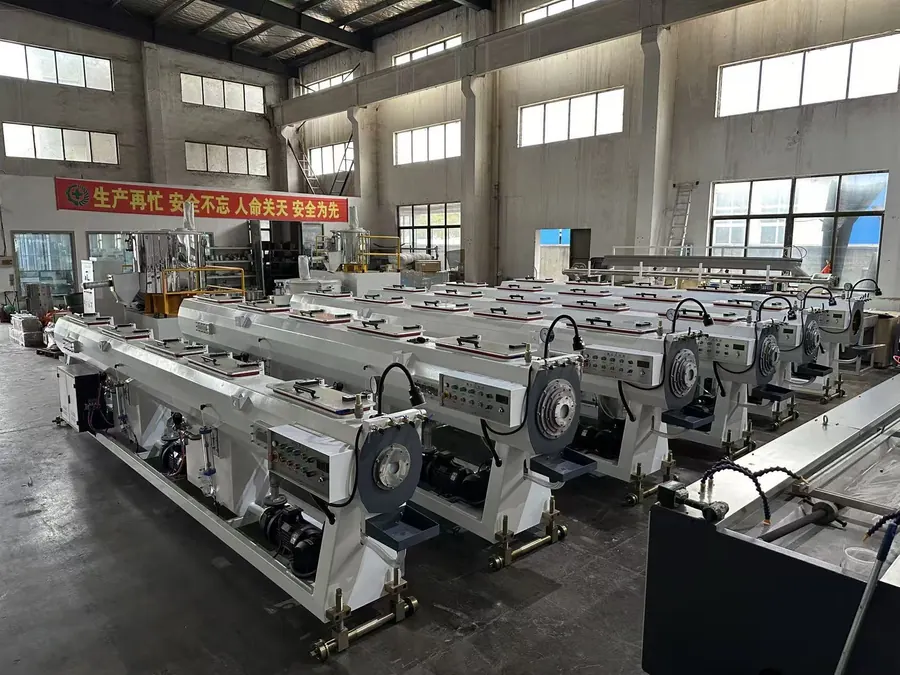
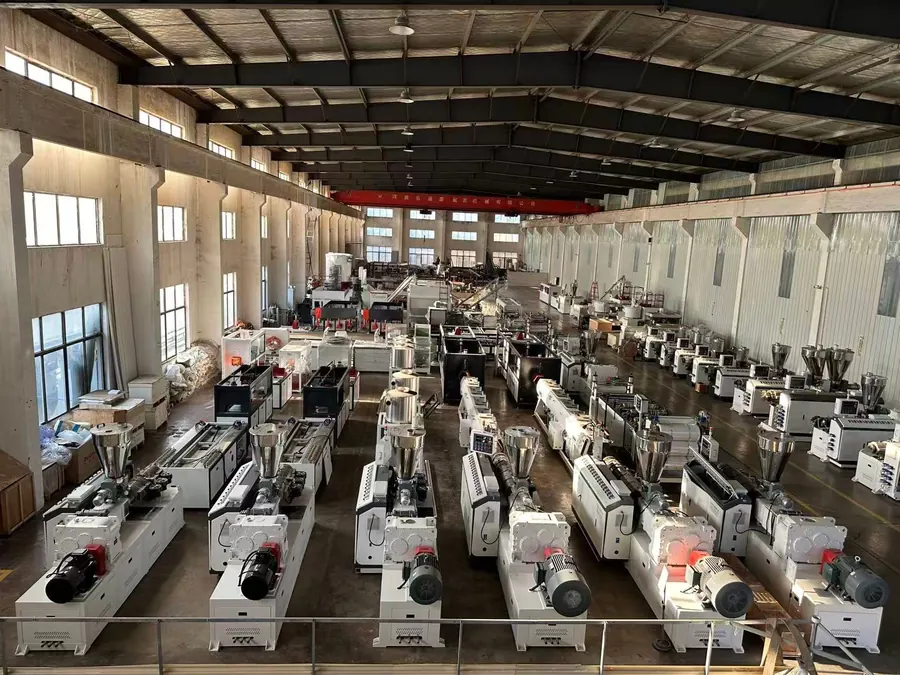
Key components such as die head, calibration sleeves, cutter parts, electrical cabinet and spare parts are checked according to pipe diameter and SDR requirements.
Medium-diameter PE pipe line equipment requires practical packing and loading planning because tanks, haul-off and cutter sections are larger and longer than small pipe lines.
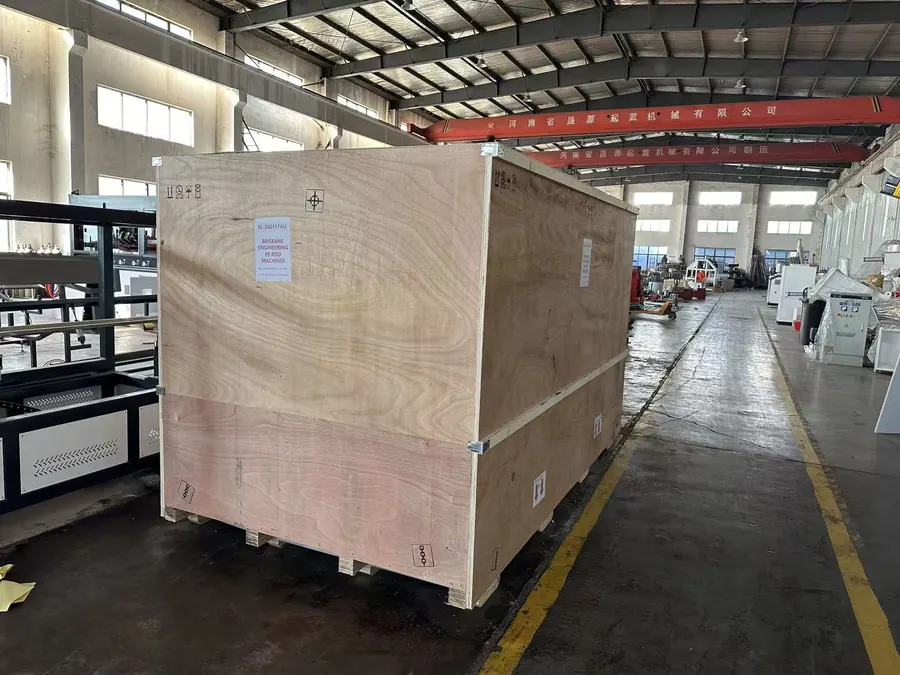
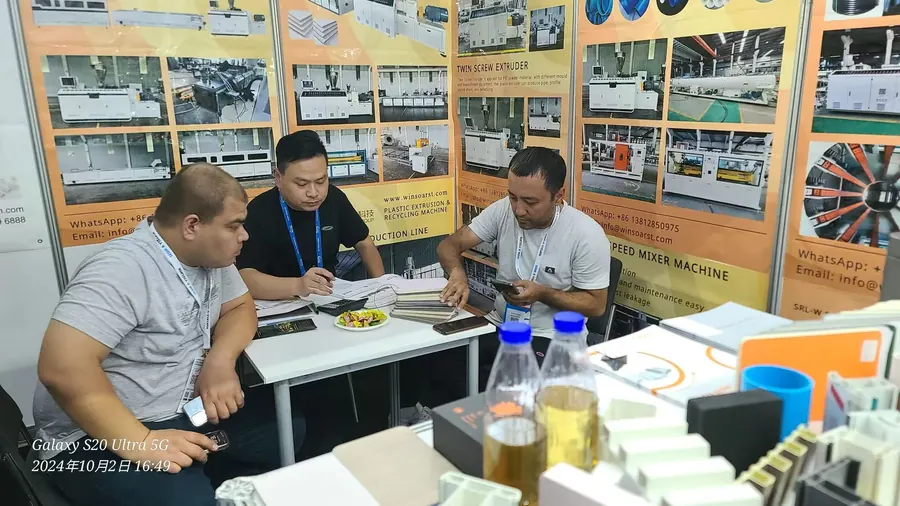
Winsoar confirms pipe diameter, SDR, fixed length, color mark line, output target, voltage and factory layout before preparing a line recommendation.
It is a medium-to-large diameter HDPE pipe extrusion line for producing straight PE pipes from 200mm to 400mm, including extrusion, color marking, calibration, cooling, hauling and chipless fixed-length cutting.
This 200-400mm page is planned for straight pipe production with chipless cutting, with downstream pipe receiving configured separately by pipe length and workshop layout. If your project requires small coiled pipe, Winsoar will recommend a different downstream configuration.
WS-450 I and WS-450 II configurations are usually the most relevant ranges. The final choice depends on maximum diameter, SDR, output target and whether 38D high-efficiency extrusion is required.
Yes. It can be configured for PE water supply pipes, PE gas pipes, irrigation main pipes, drainage pipes, cable ducts and industrial PE pipes according to the project standard.
Please provide pipe diameter range, SDR or wall thickness, material grade, application, output target, fixed pipe length, mark-line requirement, voltage and workshop layout.
Send Winsoar your diameter range, SDR, pipe standard, output target, mark-line requirement, fixed pipe length and workshop layout. We will recommend a suitable HDPE pipe extrusion line configuration.
Use these PE / HDPE pipe extrusion line guides to compare machine configuration, production process, equipment cost and diameter selection before confirming your project layout.
| Guide | When to read it |
| What Machines Are Included in a PE Pipe Production Line? | Check the complete equipment list, including extruder, die head, tanks, haul-off, cutter, coiler and stacker. |
| PE Pipe Production Line Process | Understand extrusion, vacuum calibration, cooling, haul-off and cutting process flow. |
| PE Pipe Production Line Cost | Review cost factors before requesting a PE or HDPE pipe extrusion line quotation. |
| How to Choose an HDPE Pipe Extrusion Line | Match pipe diameter range, SDR, application and output target to the right machine configuration. |