Tel : +86-13812850975 E-mail : info@winsoarst.com

Views: 0 Author: Site Editor Publish Time: 2026-08-29 Origin: Winsoar


Direct answer: A PVC hollow corrugated roofing sheet production line is a continuous extrusion system that converts PVC compound into lightweight hollow-profile roofing sheets. A typical line includes a horizontal mixer, PVC extruder, profile die and mould, vacuum calibration table, haul-off, fixed-length cutter and receiving rack. The correct configuration depends on sheet width, corrugation profile, hollow structure, thickness, output target, color, surface finish, cutting length and local electrical conditions.
PVC hollow corrugated roofing sheets are lightweight building panels with a formed corrugated surface and internal hollow structure. The profile improves stiffness without making the sheet as heavy as a solid panel. Depending on the formula and surface design, the finished sheets can be used for agricultural buildings, workshops, warehouses, temporary structures, partitions, shelters and other roofing or cladding applications.
The production line must keep the material temperature, melt pressure, profile shape and cooling conditions stable. A good quotation should therefore describe the complete line and the intended finished sheet, rather than listing only an extruder model.
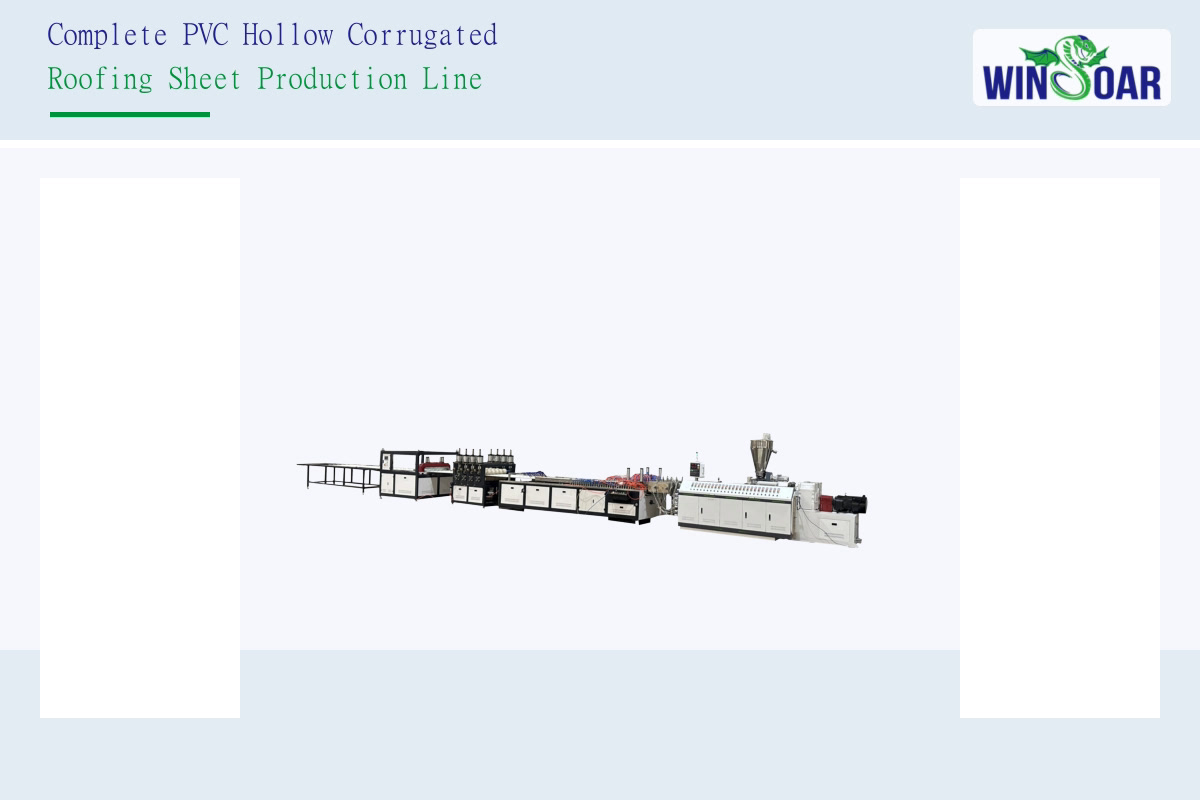
Complete PVC hollow corrugated roofing sheet extrusion and forming line.
Mix PVC resin, stabilizer, impact modifier, filler, pigment and other additives according to the target formula.
Prepare a uniform compound with controlled temperature and dispersion.
Plasticize and convey the compound through the PVC extruder.
Form the corrugated sheet section and internal hollow structure through the profile die and mould.
Control width, thickness, corrugation geometry and surface shape on the vacuum calibration table.
Maintain a consistent line speed with the haul-off and produce the required sheet length with the cutter.
Receive and protect finished panels on the receiving rack before inspection and packing.
The line speed should be matched to the cooling and haul-off capacity. Increasing extruder speed without enough calibration stability or cooling can cause profile deformation, thickness variation and unstable sheet dimensions.
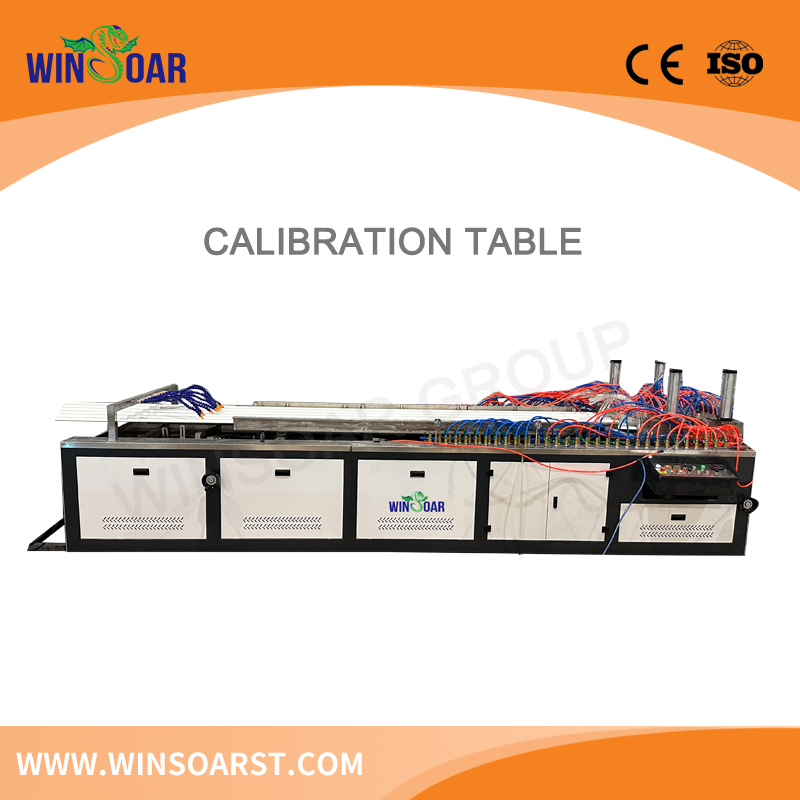
Vacuum calibration stabilizes the sheet width, thickness and corrugation profile after forming.
Mixing prepares the PVC compound before extrusion. The hot mixer helps disperse additives and remove process moisture, while the cooling stage brings the compound to a suitable feeding temperature. Stable feeding reduces melt-pressure fluctuation and helps maintain consistent sheet thickness.
The quotation should identify mixer volume, heating and cooling method, discharge arrangement, feeding height and whether automatic conveying is required.
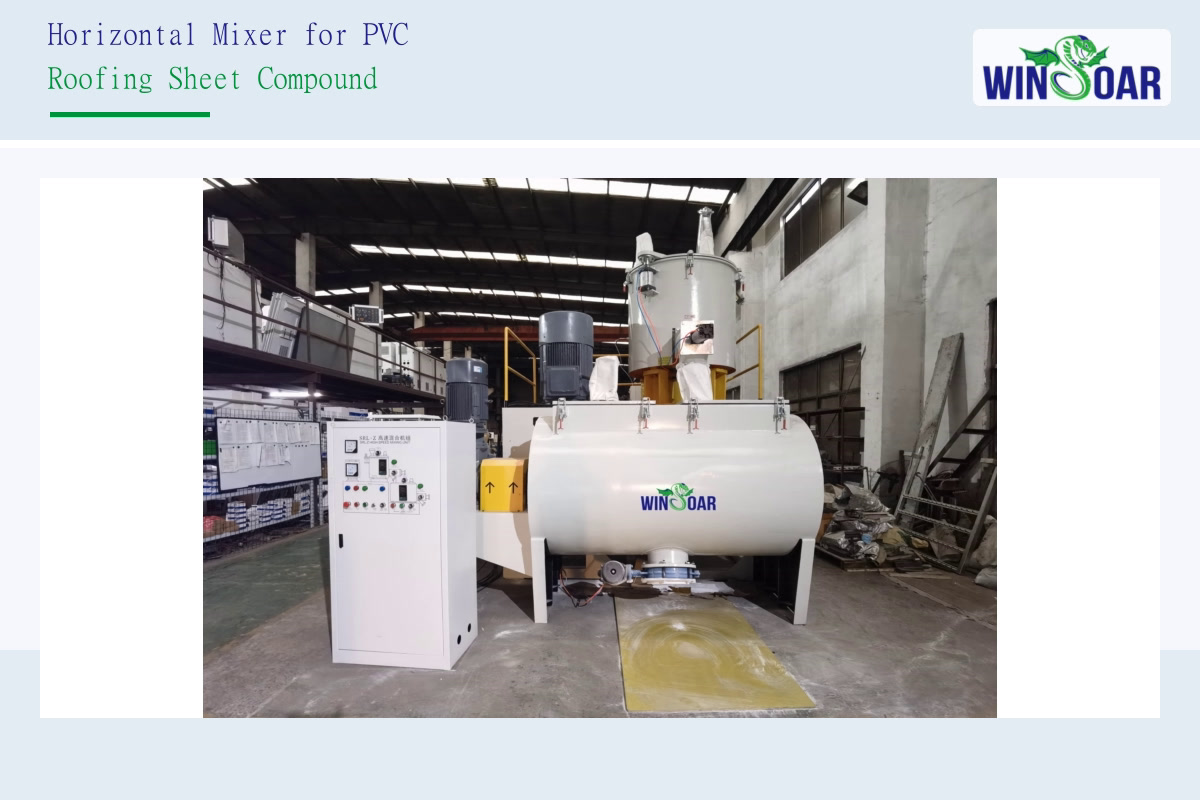
Horizontal mixing equipment prepares a consistent PVC compound for extrusion.
The extruder melts, plasticizes and conveys the PVC compound to the profile die. A conical twin-screw extruder is commonly considered for rigid PVC profiles and panels because its plasticizing and conveying behavior can be matched to PVC formulation and output requirements.
Selection should consider screw diameter, motor power, screw design, barrel heating and cooling, drive control, practical output and the expected changeover between formulas or products. Clarify whether stated output is a normal production value or a maximum test value.
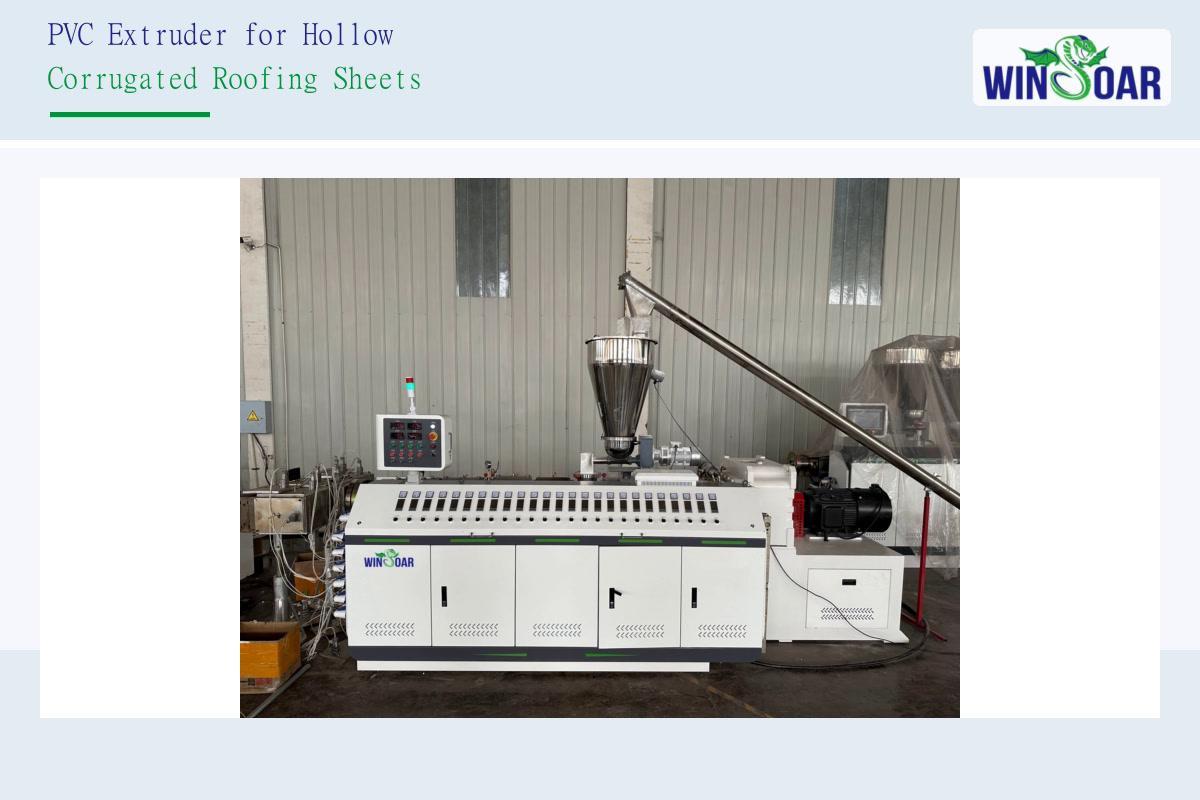
The PVC extruder provides controlled plasticizing and continuous melt delivery.
The die and mould determine the sheet width, corrugation pitch, hollow-channel geometry, wall thickness and surface appearance. Tooling should be designed around an approved profile drawing. If several widths or corrugation designs are required, list each mould set and the expected changeover method in the quotation.
Finished sheet width and usable width
Overall thickness and hollow-wall thickness
Corrugation pitch, height and shape
Single-color, co-extruded or surface-layer structure
Smooth, embossed, glazed or other surface requirement
Cutting length and allowable dimensional tolerance
The vacuum calibration table supports the hot profile while vacuum and cooling stabilize its final dimensions. It must be matched to the profile mould, sheet width, line speed and required surface quality. Water circulation, vacuum control, table length and adjustment access affect practical production stability.
The haul-off pulls the formed sheet through the cooling section at a controlled speed. Its contact surface and traction must support the sheet without marking or distorting the corrugation. The cutter is selected according to sheet thickness, width, finished length and required cut quality. The receiving rack should provide enough support for the panel length and prevent edge damage during collection.
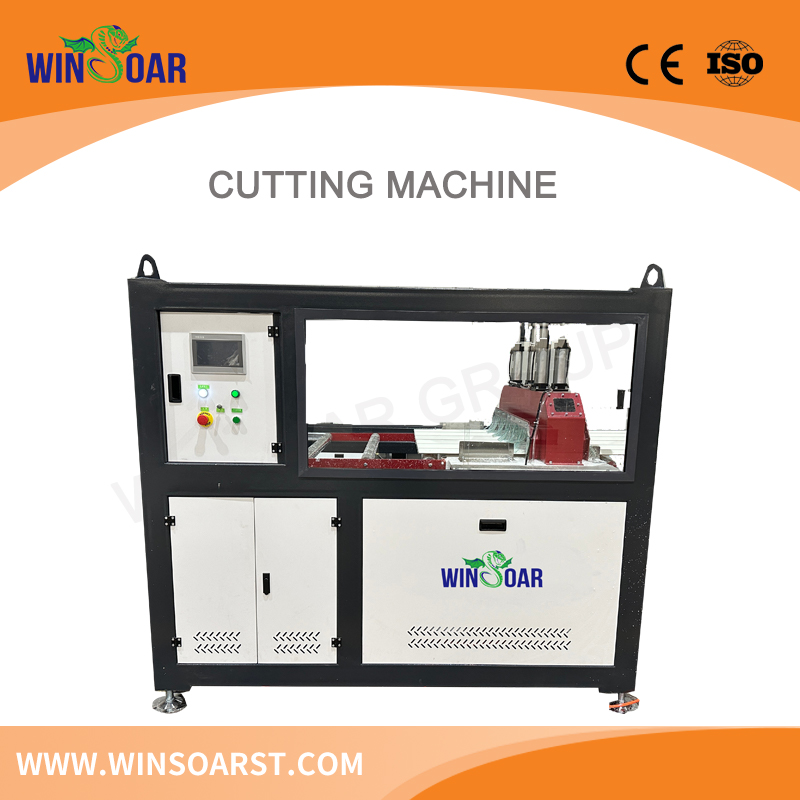
The cutter produces consistent panel lengths for inspection and packing.
PVC hollow corrugated roofing sheet performance depends on both profile design and compound formulation. The project brief should state the intended use, required weather resistance, color stability, impact performance, fire or local building requirements and surface finish.
Sheet width, length and overall thickness
Corrugation pitch and height
Hollow-channel continuity and wall uniformity
Surface gloss, color and visible marks
Edge condition after cutting
Weight per square meter
Flatness, stiffness and impact behavior
Dimensional stability after cooling
Recycled PVC or filler can be used only when the formulation, dispersion and melt strength are suitable for the required sheet. The machine supplier should receive actual material information before confirming output and tooling.
Confirm the finished sheet drawing and usable sheet width.
Define the corrugation profile and hollow structure.
Set target thickness, weight and output.
Confirm PVC resin, additives, filler and recycled-material content.
Decide whether color marking, co-extrusion or a surface layer is required.
Match the extruder, die, mould, calibration and cooling system to the profile.
Confirm cutting length, stacking method and packaging requirements.
Check workshop length, water supply, drainage, compressed air and electrical voltage.
For the complete equipment page, see the PVC Hollow Corrugated Roofing Sheet Production Line. Related equipment can also be reviewed through the Plastic Profile and Board Production Line category and the PVC and WPC Profile Production Line category.
Watch the PVC hollow corrugated roofing sheet production line running video on YouTube to review the real machine layout and downstream handling.
For a quotation, provide the profile drawing, sheet width, thickness, corrugation design, material formula, target output, finished length, color and surface requirements, factory voltage, workshop dimensions and destination country. These details allow the supplier to confirm a suitable extruder, tooling and downstream configuration.
The line is designed for PVC hollow corrugated roofing sheets and similar formed PVC profile panels when the die and mould are designed for the required section. Different widths, corrugation designs and surface treatments normally require corresponding tooling.
A conical twin-screw extruder is a common choice for rigid PVC profile and panel production, but the final model depends on the formula, sheet thickness, width, output and processing window. The supplier should confirm the choice against the actual material and profile drawing.
Possible causes include unstable feeding, incorrect melt temperature, pressure fluctuation, unsuitable die design, insufficient vacuum calibration, uneven cooling or inconsistent haul-off speed. The line should be commissioned using the intended formula and tooling.
One line can sometimes cover several widths with interchangeable tooling and suitable downstream adjustment. The practical range depends on the extruder capacity, die design, calibration table, haul-off width and cooling layout. Each required width should be listed before quotation.
Provide the profile drawing, width, thickness, corrugation pitch and height, hollow structure, material formula, target output, sheet length, color, surface finish, local voltage, workshop conditions and destination. This is more reliable than requesting a quotation from the product name alone.