Tel : +86-13812850975 E-mail : info@winsoarst.com

Views: 0 Author: Site Editor Publish Time: 2026-08-23 Origin: Winsoar


Direct answer: The price of a PVC pipe extrusion line is mainly determined by the pipe diameter range, wall thickness, required output, PVC formulation, extruder configuration, die head and mould, vacuum calibration and cooling system, haul-off and cutter, belling or coiling requirements, automation level and factory utilities. A reliable quotation should be based on the finished pipe drawing and production target, not only on the motor power or extruder model.
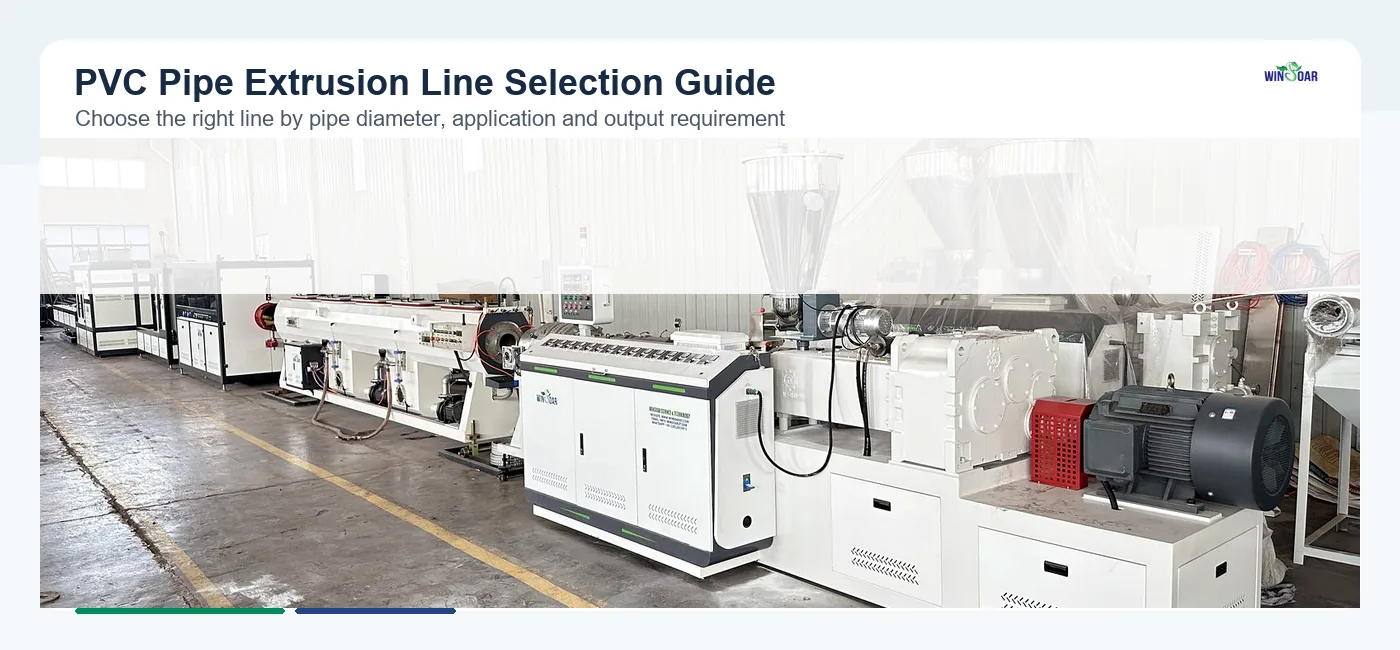
PVC pipe extrusion line configuration should be matched to the finished pipe and production target.
Diameter range is one of the first cost factors because it affects the die head, sizing moulds, vacuum calibration tank, cooling length, haul-off and cutter. A line for small electrical conduit is configured differently from a line for large water or drainage pipe.
The quotation should identify the minimum and maximum pipe diameter, wall thickness or SDR, solid-wall or multi-layer structure, finished pipe length, application and applicable local standard.
PVC pipe range | Typical project focus | Main configuration question |
|---|---|---|
16-63mm | Electrical conduit, water and small utility pipe | High-speed sizing, stable haul-off and accurate cutting |
63-160mm | Water supply, drainage and utility pipe | Die-head flexibility, cooling capacity and belling option |
50-250mm | Medium-diameter pressure and drainage pipe | Output, vacuum calibration length and downstream handling |
200-450mm | Large water, drainage and municipal pipe | Heavy-duty haul-off, longer cooling and large-diameter cutter |
PVC pipe lines commonly use a conical twin screw extruder because PVC requires controlled plasticizing and stable melt pressure. The extruder price depends on screw diameter, motor power, screw design, barrel heating and cooling, drive system, control cabinet and expected output.
A rigid PVC pressure pipe, electrical conduit and drainage pipe may use different filler ratios, additives, stabilizers and target weights. Do not compare quotations only by motor power. Check the screw design, practical output target, formulation and whether the quoted output is a maximum or a normal production value.
The die head and sizing mould form the pipe section. Their price depends on pipe diameter, wall thickness, layer structure, material flow design and the number of interchangeable sizes required.
Single-layer die head for standard PVC pipe
Multi-layer die head for different material or recycled-content layers
Co-extrusion unit for color stripes or identification lines
Interchangeable mould sets for multiple diameters
Special flow design for thick-wall or high-output pipe

Die head, mould, calibration and downstream components all contribute to the project quotation.
Vacuum calibration controls the outside diameter, roundness and surface quality after the melt leaves the die head. Cooling removes heat before the pipe reaches the haul-off and cutter.
The price is affected by calibration tank length, vacuum pump, water circulation, spray cooling sections, water temperature control, pipe diameter, wall thickness and required line speed. Large or thick-wall PVC pipes normally need more cooling capacity and a longer downstream layout.
The haul-off must provide stable traction without damaging the pipe surface. The cutter is selected according to pipe diameter, wall thickness, finished length and chip-free requirements. Some projects also require a pipe belling machine for socketed water or drainage pipe, which adds shaping, cooling and handling requirements.
Automation affects both initial price and production consistency. A basic line may include PLC control, temperature control, water-level control and manual adjustment. A higher automation configuration may add recipe storage, automatic vacuum regulation, metered feeding, online monitoring, automatic length counting and centralized line synchronization.
Confirm local voltage, compressed air, cooling-water supply, drainage, workshop length, material storage, installation, commissioning, operator training, spare parts and warranty scope. Two quotations with similar machine names may have different total project costs when one includes installation and tooling while the other does not.
PVC pipe application and standard
Diameter range and wall thickness
PVC formula or material information
Target output in kg/h or meters per minute
Single-layer, multi-layer or color-marking requirement
Required pipe lengths and cutter type
Belling, coiling or stacking requirement
Local electrical specification
Factory space and cooling-water conditions
Delivery date, installation and training scope
The diameter range, required output and machine configuration usually have the greatest effect. Die heads, moulds, cooling capacity and downstream handling must match the pipe specification.
It is a common configuration for rigid PVC pipe production, but the exact extruder model and motor power should be selected according to formulation, diameter, wall thickness and output.
Not always, but large-diameter lines normally require larger tooling, stronger haul-off, longer cooling and heavier cutting or handling equipment.
The vacuum calibration tank helps control outside diameter, roundness and surface quality while the hot pipe is being shaped and cooled.
Provide the pipe drawing or diameter and wall thickness, application, material formula, output target, finished length, cutter or belling requirement, local voltage and factory conditions.
Winsoar can match a PVC pipe extrusion line to the target diameter range, output, formulation, pipe application and workshop conditions. Prepare the project data above before requesting a quotation so the proposed extruder, die head, mould, calibration, cooling and downstream equipment can be evaluated as one complete line.