Tel : +86-13812850975 E-mail : info@winsoarst.com

Views: 0 Author: Site Editor Publish Time: 2026-07-04 Origin: Site


Short answer: a PVC pipe extrusion line can typically produce from about 100 kg/h to more than 800 kg/h, depending on pipe diameter, wall thickness, PVC formulation, extruder model, cooling length, haul-off speed and whether the line is single-output, two-cavity or multi-cavity. Small conduit pipe lines often focus on high line speed and multiple outputs, while medium and large PVC pipe lines usually require stronger extrusion capacity and longer cooling sections.
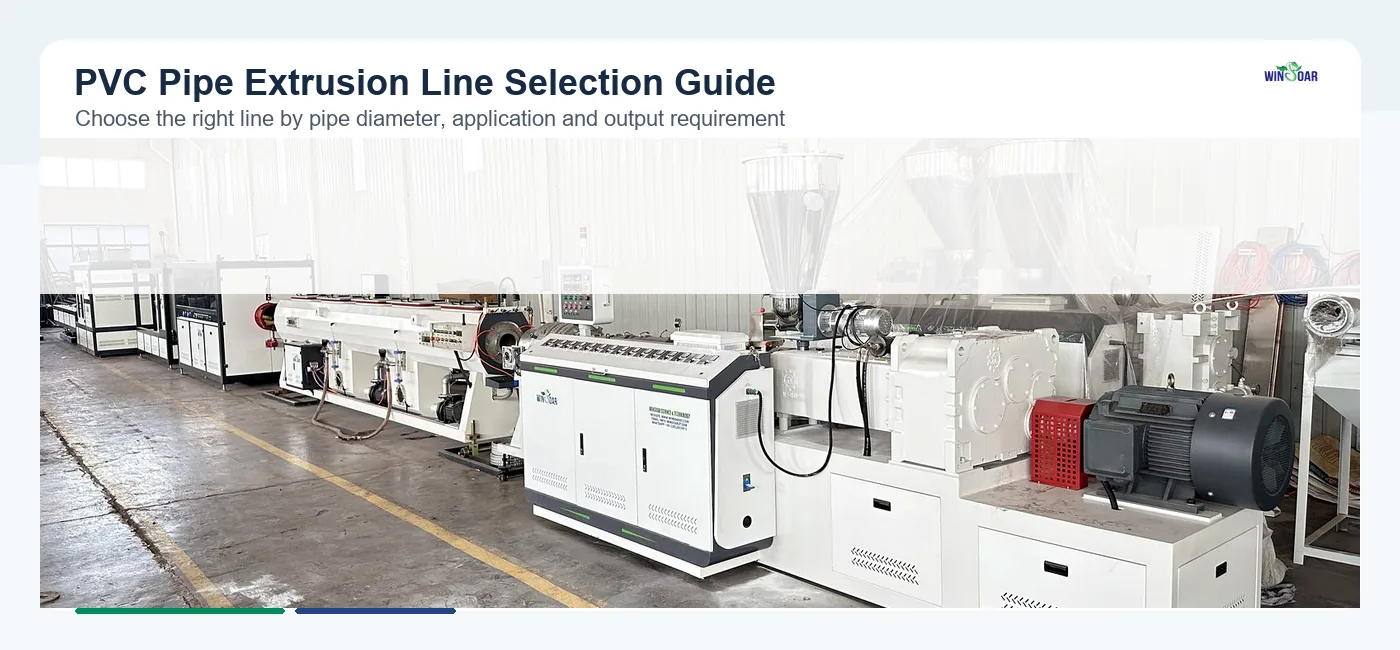
PVC pipe extrusion line output depends on pipe diameter, wall thickness, cooling length and downstream matching.
This article explains how to estimate PVC pipe production line output before requesting a quotation. It is written for buyers comparing a PVC pipe extrusion line, PVC pipe production line, PVC pipe machine or PVC pipe making machine for water supply pipe, drainage pipe, conduit pipe, irrigation pipe and industrial pipe projects.
If you are still deciding which pipe diameter range is suitable for your project, first read this guide: How to Choose a PVC Pipe Extrusion Line for Different Pipe Diameter Ranges.
The table below gives a practical reference for typical PVC pipe extrusion output. The final value must be confirmed according to your target pipe diameter, wall thickness, material formula, pipe standard and factory conditions.
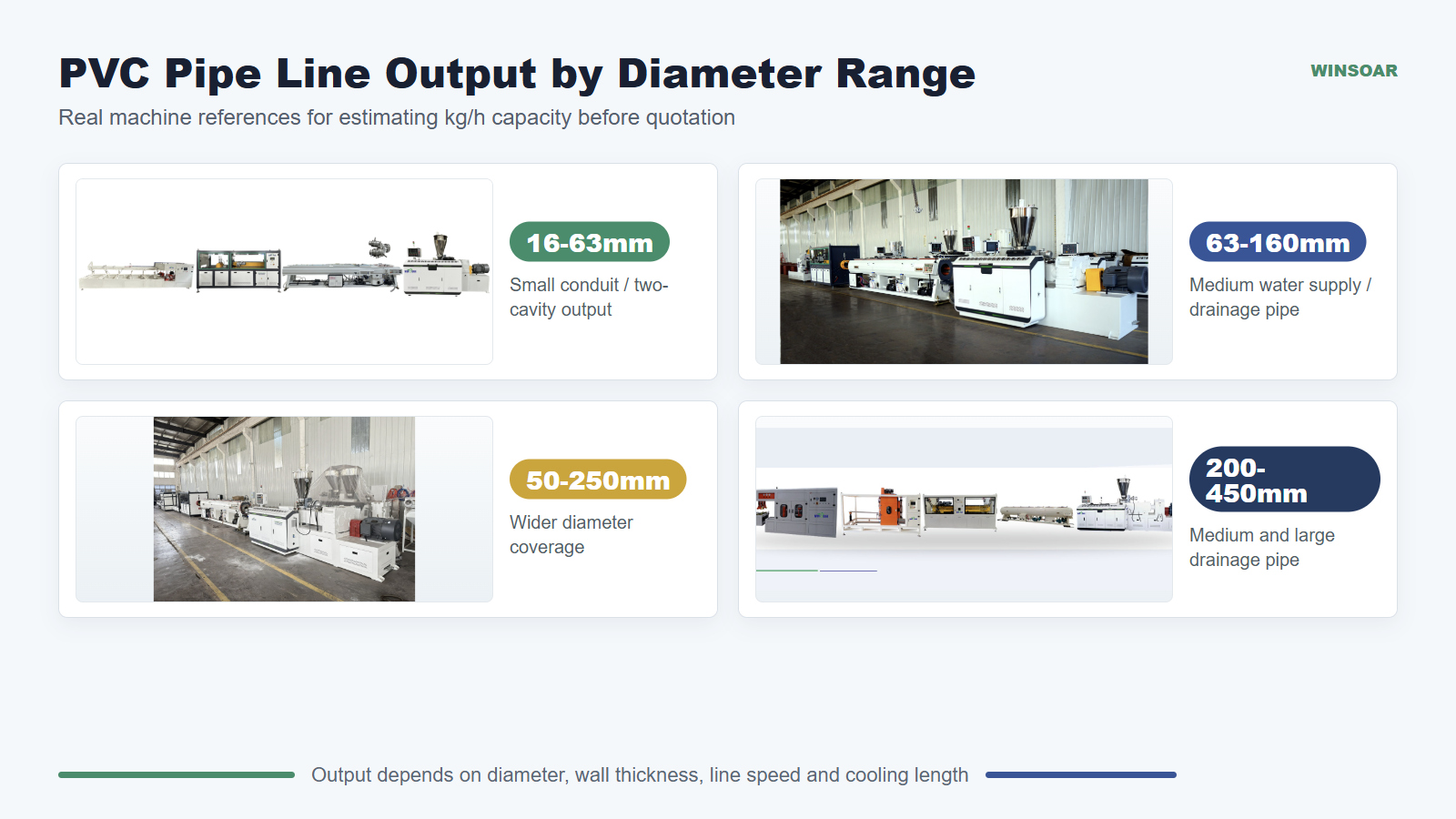
Different pipe diameter ranges need different extruder output, cooling length and haul-off configuration.
Pipe Diameter Range | Typical Line Type | Reference Output | Main Capacity Limiting Factors | Related Winsoar Page |
|---|---|---|---|---|
16-63mm | Small-diameter single-output or two-cavity PVC pipe machine | About 100-250 kg/h | Extruder size, cavity number, cooling stability, cutting speed | |
63-160mm | Medium-diameter PVC pipe production line | About 180-350 kg/h | Wall thickness, pipe standard, vacuum tank and haul-off matching | |
50-250mm | Wider-range PVC pipe extrusion line | About 250-450 kg/h | Diameter coverage, extruder output, cooling length, cutting stability | |
200-450mm | Medium and large diameter PVC pipe extrusion line | About 400-800 kg/h | Large pipe cooling, haul-off force, pipe weight per meter, belling requirement |
These are reference ranges, not fixed guarantees. A smaller pipe can run at a faster line speed but may have lower weight per meter. A larger pipe may use more material per meter but run at a slower speed because cooling, pulling and cutting become more demanding.
Many buyers ask for the extruder output first, such as 250 kg/h, 450 kg/h or 800 kg/h. This is important, but a complete PVC pipe production line is a system. Even if the extruder can plasticize enough material, the real hourly output may still be limited by pipe cooling, vacuum calibration, haul-off force, cutting accuracy, belling speed or operator setup.
For example, a small-diameter conduit pipe line can use two-cavity production to increase quantity per hour. A large drainage pipe line cannot simply increase speed in the same way, because the pipe wall needs enough cooling time to maintain roundness and dimensional stability.
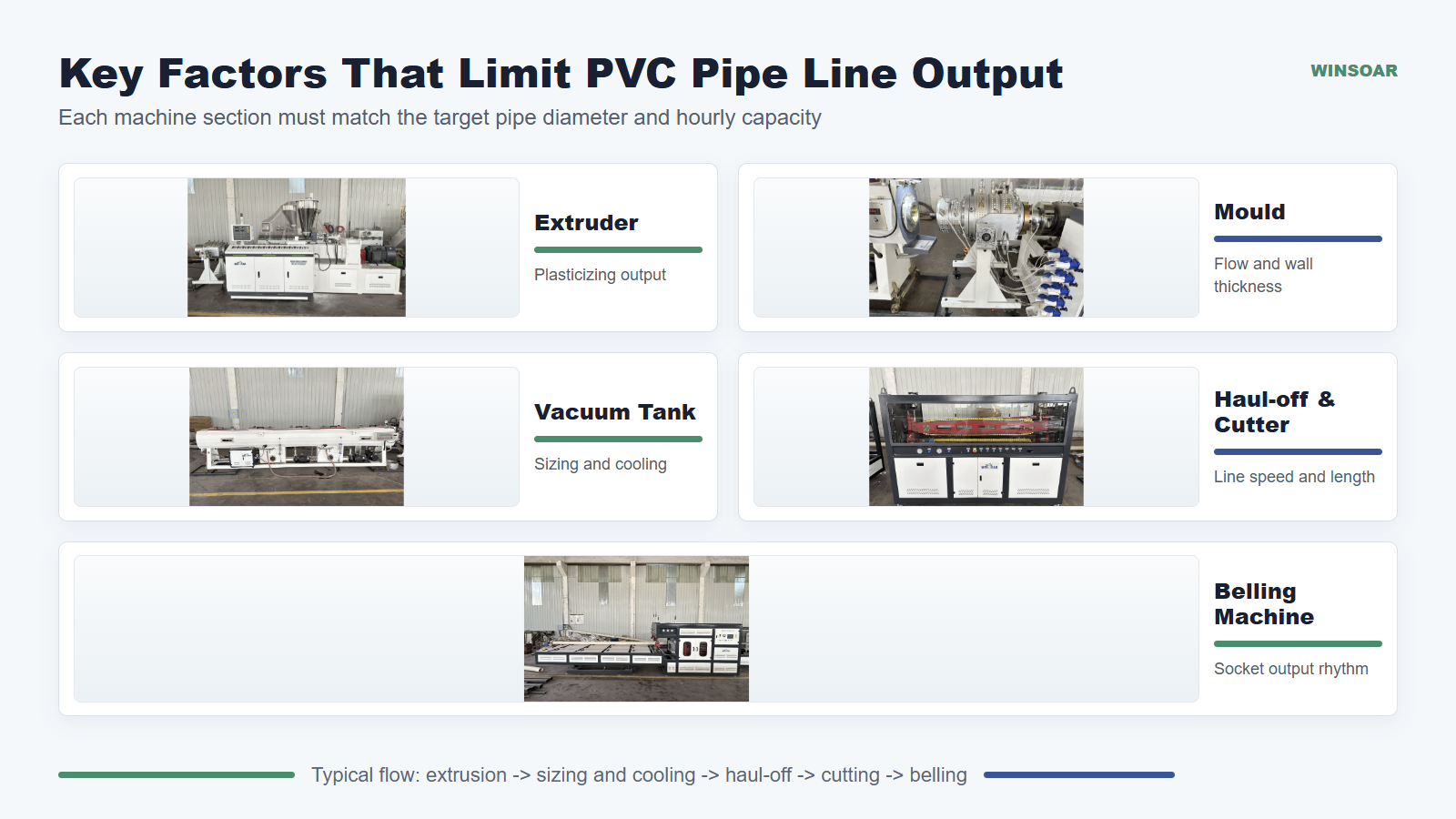
Extruder, mould, vacuum calibration, cooling, haul-off, cutter and belling machine all affect real hourly output.
Pipe diameter affects both line speed and pipe weight. Small diameter PVC pipes usually have lower weight per meter, so they can run faster. Medium and large pipes have higher weight per meter, but they require slower and more stable production.
For a 16-63mm PVC pipe machine, output is often improved by using two-cavity production. This is useful for electrical conduit pipe, small water pipe and cable protection pipe markets where the order quantity is high and the pipe diameter is relatively small.
For a 200-450mm PVC pipe extrusion line, the main concern is not only kg/h output. Buyers also need stable pipe roundness, sufficient cooling length, strong haul-off traction, reliable cutting and optional belling for socket pipe production.
Two PVC pipes with the same outside diameter can have very different output requirements if the wall thickness is different. A thick-wall pipe uses more material per meter and needs longer cooling time. A thin-wall drainage or conduit pipe may run faster, but it still needs stable calibration to avoid ovality and wall thickness variation.
This is why suppliers should not quote only from pipe outside diameter. For a serious quotation, provide pipe wall thickness, pipe standard or pressure rating. These details help calculate approximate pipe weight, extrusion load, cooling requirement and line speed.
PVC pipe production usually uses PVC resin with stabilizer, lubricant, filler, processing aid and other additives. Different formulations can affect plasticizing behavior, melt pressure, surface quality and motor load. A highly filled formulation may reduce material cost, but it can also change extrusion stability and screw load.
For rigid PVC and UPVC pipe production, a conical twin screw extruder is commonly used because it is suitable for PVC powder processing. However, the final output still depends on screw design, gearbox strength, motor power, barrel temperature control and material feeding stability.
Cooling is one of the most important limits in PVC pipe extrusion. After the pipe leaves the die head, it must pass through vacuum calibration and cooling before it can be pulled, cut and handled. If the pipe is not cooled enough, it may become oval, deform during haul-off, or show unstable diameter.
Small pipes need accurate but compact cooling. Medium and large pipes need longer tanks and more stable spray cooling. For wide-diameter lines such as 50-250mm PVC pipe extrusion lines, the cooling system must be selected according to the largest planned pipe size, not only the smallest size.
The haul-off machine controls the pulling speed of the pipe. If the haul-off is unstable, pipe wall thickness and outside diameter can fluctuate. For larger PVC pipes, the haul-off machine must provide enough traction force and stable synchronization with extrusion speed.
The cutting machine also affects practical output. Small pipes require fast and accurate cutting, especially in two-cavity production. Larger pipes require stronger cutting structure, dust control and stable length measurement. If the cutter cannot keep up with the line, the real production speed must be reduced.
Many PVC drainage pipes, sewage pipes, water supply pipes and conduit pipes require socket ends. In this case, the pipe belling machine should be considered in the total output plan. A fast extrusion line is not enough if the downstream belling process cannot match production speed.
When asking for a PVC pipe extrusion line quotation, tell the supplier whether the line needs online belling, offline belling, U-type socket, R-type socket or another socket design.
A simple way to discuss PVC pipe production capacity is to start with three questions:
What pipe diameter do you want to produce?
What is the pipe wall thickness or pipe standard?
How many kilograms per hour or meters per hour do you expect?
Output in kg/h is related to pipe weight per meter and line speed. In simple terms:
Estimated output = pipe weight per meter x line speed x 60 minutes
This formula is useful for discussion, but the final machine selection still depends on the extruder model, die design, cooling system, haul-off, cutter and belling process.
Buyer A wants to produce 63mm electrical conduit pipe with thin wall and high quantity. Buyer B wants to produce 63mm water supply pipe with thicker wall and stricter pressure requirements. Both buyers mention 63mm PVC pipe, but their output expectation, mould requirement and production stability requirement may be different.
Buyer A may focus on high-speed or two-cavity production. Buyer B may care more about wall thickness accuracy, pressure pipe quality and stable cooling. This is why Winsoar asks for pipe application, wall thickness and output requirement before recommending a line.
The 16-63mm PVC Pipe Machine is suitable for small diameter PVC pipe production, including electrical conduit pipe, cable protection pipe and small water pipe. Two-cavity configuration can improve production efficiency for small pipes.
The 63-160mm PVC Pipe Machine is designed for common medium-diameter pipe production. It is suitable for water supply, drainage, conduit and industrial pipe applications where balanced output and stable sizing are important.
The 50-250mm PVC Pipe Extrusion Line gives broader diameter coverage. It is useful when a factory wants one PVC pipe production line to cover multiple pipe sizes from medium to larger drainage or water supply pipes.
The 200-450mm PVC Pipe Extrusion Line is positioned for medium and large PVC pipe projects, including municipal drainage, sewage, irrigation and thick-wall industrial pipe production. Output planning should consider cooling length, haul-off force and belling requirements.
To estimate the output of a PVC pipe extrusion line more accurately, prepare the following information before contacting a supplier:
Information | Why It Affects Output |
|---|---|
Pipe outside diameter | Determines mould size, cooling demand and downstream equipment size |
Pipe wall thickness | Affects pipe weight per meter and cooling time |
Pipe application | Different applications require different standards and quality focus |
Pipe standard or pressure rating | Helps confirm wall thickness, tolerance and production stability |
Expected output | Helps select extruder model and line configuration |
Material formulation | Filler ratio and additives affect plasticizing and motor load |
Belling requirement | Socket forming can affect total production rhythm |
Workshop size | Determines whether the line has enough space for cooling and handling |
Voltage and frequency | Needed for motor and electrical system configuration |
A maximum kg/h number does not always represent stable long-term production. Ask what pipe size, wall thickness, material formula and line speed were used for that capacity.
Output in kg/h and output in meters per hour are not the same. Large thick-wall pipes consume more material per meter, while small thin-wall pipes may run faster but use less material per meter.
A very wide diameter range may look attractive, but it can increase investment, workshop space and energy consumption. The best line should match the pipe sizes you will produce most often.
Cooling and belling can limit real production speed. This is especially important for medium and large PVC drainage pipe, sewage pipe and socket pipe projects.
id="Conclusion">ConclusionThe output of a PVC pipe extrusion line is not a single fixed number. It depends on pipe diameter, wall thickness, material formula, extrusion capacity, cooling length, haul-off stability, cutting speed and belling requirement. A practical output estimate should be based on the pipe products you plan to manufacture most often.
Tell Winsoar your target pipe diameter, wall thickness, pipe application, pipe standard and expected output. We can recommend a suitable PVC pipe production line configuration and explain the estimated hourly capacity for your project.
Use these PVC pipe production line resources to compare machine selection, output planning, process flow and real running video solutions by diameter range.
| Resource | Use it for |
| 16-32mm PVC One Out Four Pipe Extrusion Line | Review four-cavity one out four small PVC conduit and UPVC pipe production. |
| PVC Pipe Production Line category | Compare available PVC pipe extrusion machine ranges. |
| PVC Pipe Production Line Process | Review mixing, extrusion, calibration, cooling, cutting and belling process flow. |
| How to Choose a PVC Pipe Extrusion Line | Choose by application, pipe diameter, wall thickness, formula and downstream configuration. |
| PVC Pipe Extrusion Line Output Capacity Per Hour | Estimate practical output from diameter, wall thickness, formula, cooling and belling requirements. |
PVC running video solutions: 16-32mm PVC one out four video solution, 16-63mm PVC video solution, 63-160mm PVC video solution, 50-250mm PVC video solution and 200-450mm PVC video solution.