Tel : +86-13812850975 E-mail : info@winsoarst.com

Views: 0 Author: Site Editor Publish Time: 2026-07-03 Origin: Site


Choosing a PVC pipe extrusion line is not only about selecting a pipe diameter range. A practical PVC pipe production line should match the final pipe application, wall thickness, output target, available workshop space, cooling requirement, socket type and long-term product plan.
For buyers comparing different PVC pipe machines, the most important question is usually simple: which line range is suitable for my pipe project? A small conduit pipe line, a medium water supply pipe line and a large drainage pipe line may all be called PVC pipe extrusion lines, but their machine configuration, cooling length, haul-off force and investment level can be very different.
This guide explains how to choose a PVC pipe extrusion line by pipe diameter range, including 16-63mm, 63-160mm, 50-250mm and 200-450mm PVC pipe production projects.
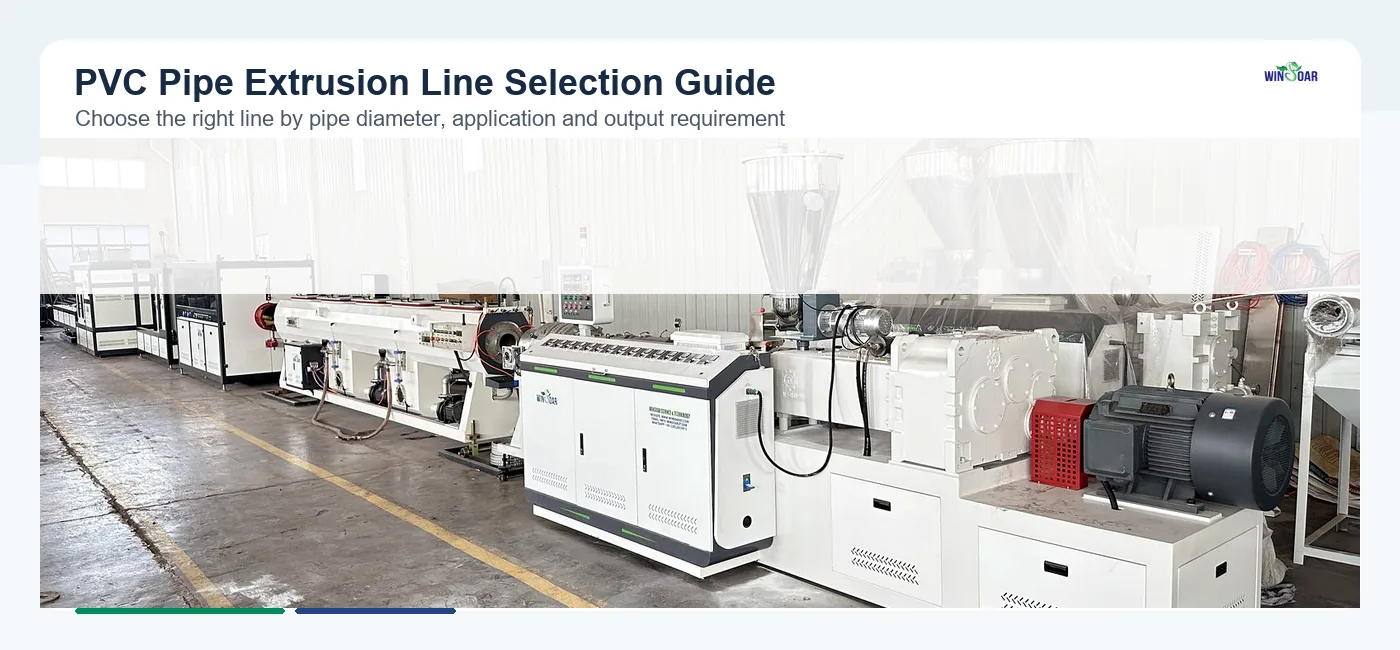
PVC pipe extrusion line selection guide with real Winsoar production line reference
If your main products are small electrical conduit pipes or small water pipes, a 16-63mm PVC pipe machine is usually the starting point. If your factory plans to produce common water supply, drainage or conduit pipes in a medium range, a 63-160mm PVC pipe machine can be more suitable. If your project needs a wider range from small to medium-large pipes, a 50-250mm PVC pipe extrusion line gives broader production coverage. If your main products are medium and large drainage, sewage, irrigation or industrial pipes, a 200-450mm PVC pipe extrusion line should be considered.
The table below gives a simple comparison before detailed selection.
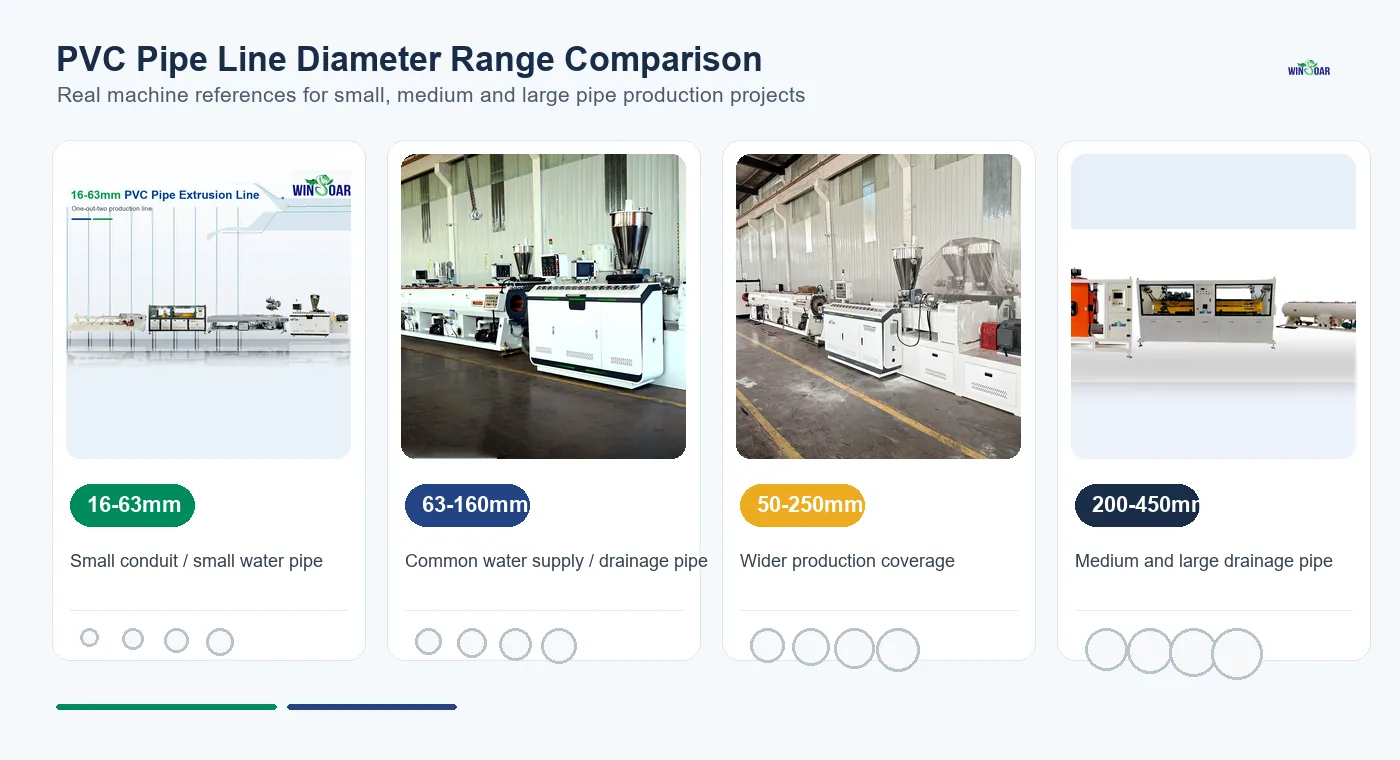
PVC pipe extrusion line diameter range comparison from 16-63mm to 200-450mm
Pipe Diameter Range | Typical Applications | Main Selection Focus | Suitable Buyer Type |
|---|---|---|---|
16-63mm | Electrical conduit, cable protection pipe, small water pipe | High efficiency, two-cavity option, stable small pipe production | Buyers focused on small-diameter pipe output |
63-160mm | Water supply, drainage, conduit and industrial pipe | Balanced production range, stable sizing, flexible mould change | Factories producing common medium pipes |
50-250mm | Drainage, water supply, irrigation and wider product range | Broader diameter coverage and stronger downstream matching | Buyers who need one line to cover more pipe sizes |
200-450mm | Municipal drainage, sewage, irrigation and thick-wall industrial pipe | Cooling length, haul-off force, cutting stability and belling | Buyers focused on medium and large diameter pipe projects |
Before comparing machine models, confirm what type of PVC pipe you want to produce. Different pipe applications can require different wall thickness, pipe standards, socket types and production stability.
Common PVC and UPVC pipe applications include:
Electrical conduit pipe
Cable protection pipe
Water supply pipe
Drainage pipe
Sewage pipe
Irrigation pipe
Industrial fluid pipe
Thick-wall PVC or UPVC pipe
For electrical conduit pipe, buyers often care about high output, smooth pipe surface and stable small diameter production. For water supply pipe, diameter accuracy, wall thickness control and pipe standard matching are important. For drainage and sewage pipe, larger diameter, stable cooling, reliable haul-off and optional pipe belling become more important.
This is why choosing only by pipe diameter is not enough. The same pipe diameter may require a different PVC pipe extrusion machine configuration if the pipe standard, wall thickness or socket requirement changes.
A 16-63mm PVC pipe machine is usually used for small diameter PVC and UPVC pipes. Typical products include electrical conduit pipes, cable protection pipes and small water pipes.
For this range, buyers often focus on production efficiency. A two-cavity PVC pipe production line can produce two pipes at the same time, which is useful when the target pipe sizes are small and the market requires higher quantity.
When choosing a 16-63mm PVC pipe extrusion line, pay attention to:
Whether the line is single-output or two-cavity configuration
Pipe diameter range and mould list
Extruder output and screw design for PVC powder material
Vacuum calibration and cooling stability for small pipes
Haul-off and cutting synchronization
Whether pipe socketing or belling is needed
This range is suitable when your main business is small-diameter PVC pipe production rather than large pipe projects. It is also a good entry product line for factories that want to start with conduit pipe or small water pipe markets.
A 63-160mm PVC pipe machine is more focused on medium-diameter pipe production. It can be used for water supply pipes, drainage pipes, conduit pipes and some industrial pipe applications.
Compared with a small-diameter line, this range needs stronger attention to pipe sizing, cooling and downstream traction. The vacuum calibration tank, cooling tank, haul-off machine and cutting machine should be selected according to the pipe diameter, wall thickness and output target.
A 63-160mm PVC pipe production line is often suitable for buyers who want a stable and practical line for common market pipe sizes. It is not as broad as a 50-250mm line, but it can be a focused choice when your main pipe sizes are concentrated in the medium range.
Important selection points include:
Target pipe diameters such as 63mm, 75mm, 90mm, 110mm, 125mm and 160mm
Pipe application: water supply, drainage, conduit or industrial pipe
Pipe wall thickness and local standard
Vacuum calibration tank length
Haul-off structure and pulling stability
Cutting method and pipe length control
Optional belling machine for socket pipe production
For buyers comparing 63-160mm and wider pipe ranges, the key question is whether 160mm is close to your upper production limit or whether you will soon need 200mm, 250mm or larger pipe sizes.
A 50-250mm PVC pipe extrusion line is suitable when the buyer wants a wider production range from small-medium pipes to larger drainage or water supply pipes. It can help factories cover more market demand with one production line, especially when the final product plan includes several pipe sizes.
This type of PVC pipe production line needs a balanced configuration. It must handle smaller pipe sizes without wasting too much energy, while also supporting larger pipe sizes that require stronger downstream equipment.
For a 50-250mm PVC pipe line, focus on:
Whether the extruder model can support the expected output range
Mould and calibration sleeve list for target diameters
Vacuum tank and cooling tank length
Haul-off force for larger pipe sizes
Cutting machine stability
Belling machine requirement for drainage pipe or socket pipe
Workshop length and line layout
This range is often a practical choice for buyers who do not want to limit production to only small or medium pipe sizes. However, if most of your future orders are 200mm to 450mm pipes, a larger line may be more suitable.
A 200-450mm PVC pipe extrusion line is designed for medium and large diameter PVC or UPVC pipe projects. Typical applications include municipal drainage pipe, sewage pipe, irrigation pipe, large water supply pipe and thick-wall industrial pipe.
Compared with small-diameter PVC pipe lines, this range requires longer cooling sections, stronger haul-off force, stable cutting performance and larger downstream equipment matching. The line should be selected around real pipe standards and long-term production needs.
For this diameter range, buyers should pay close attention to:
Extruder output and PVC plasticizing stability
Pipe die head and mould design
Vacuum calibration tank structure
Spray cooling tank length
Haul-off machine traction force
Cutting method for large pipes
Pipe belling machine and socket type
Container loading, installation and factory layout
A 200-450mm PVC pipe machine is usually not selected only for occasional large pipe production. It is more suitable when medium and large diameter pipe orders are part of the factory's main business plan.
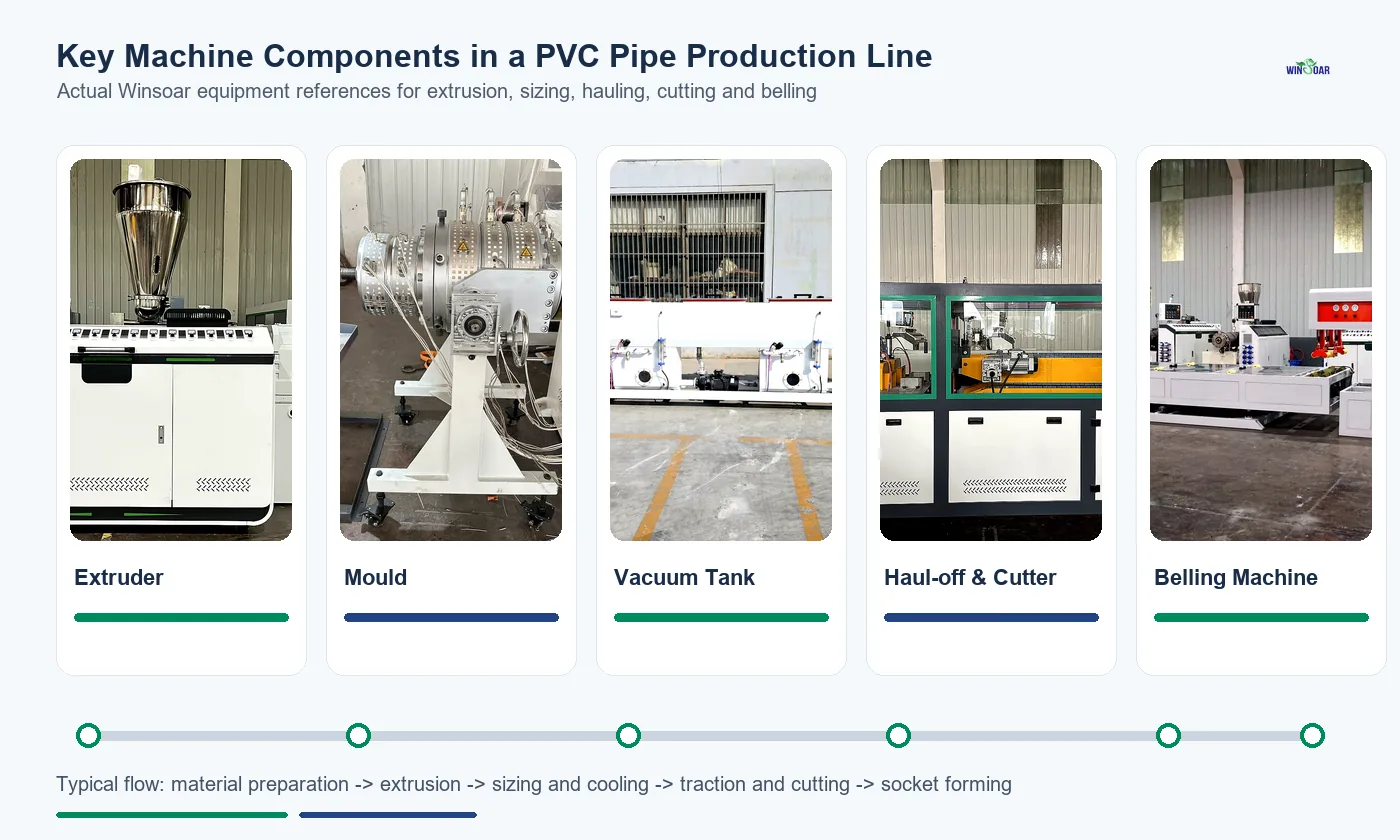
Key machine components in a PVC pipe production line
A complete PVC pipe extrusion line usually includes several main machines. The exact configuration depends on pipe diameter, pipe application and output requirement.
The mixing system prepares PVC compound before extrusion. Stable mixing helps improve feeding consistency, pipe surface quality and production stability.
PVC pipe production commonly uses a conical twin screw extruder. The extruder model should be selected according to material formula, pipe diameter, wall thickness and target output.
The pipe die head and mould are important for pipe diameter accuracy, wall thickness distribution and surface condition. Different pipe diameters require different mould and calibration parts.
The vacuum calibration tank shapes the pipe and helps control the outside diameter. Larger pipes usually require stronger tank structure and longer cooling support.
Cooling length should match pipe wall thickness and production speed. For medium and large diameter pipes, additional spray cooling is often needed.
The haul-off machine pulls the pipe at a stable speed. Pulling force and synchronization are more important as pipe diameter and weight increase.
The cutting machine should match pipe diameter and required pipe length. For larger pipes, cutting stability and dust control may become important.
A PVC pipe belling machine forms socket ends for pipe connection. It is commonly used for drainage, sewage, water supply and conduit pipe applications.
To recommend a suitable PVC pipe extrusion line, a manufacturer needs more than a general pipe diameter range. Before asking for quotation, prepare the following information:
Information Needed | Why It Matters |
|---|---|
Target pipe diameters | Determines moulds, calibration sleeves and downstream size |
Pipe wall thickness | Affects extruder output, cooling length and line speed |
Pipe application | Helps select configuration for water supply, drainage, conduit or sewage pipe |
Pipe standard | Determines size tolerance, socket type and technical requirements |
Expected output | Helps choose extruder model and downstream capacity |
Voltage and frequency | Needed for electrical configuration |
Workshop size | Helps design line layout and installation plan |
Belling requirement | Determines whether a pipe belling machine is needed |
Automation level | Affects feeding, cutting, control system and labor requirement |
Clear project information helps avoid both under-configured and over-configured solutions.
A low-price PVC pipe machine may not match your pipe standard, output target or long-term production plan. If the extruder, cooling tank, haul-off or cutter is under-configured, the line may be difficult to run stably.
Two pipes with the same outside diameter can require very different output and cooling if the wall thickness is different. Always provide pipe wall thickness or pipe standard before quotation.
If your market may soon require larger pipe sizes, choosing a very narrow pipe range can limit future orders. On the other hand, buying a much larger line than needed can increase investment and energy cost.
Many drainage, sewage and conduit pipe projects require socketed pipe ends. If belling is required, the belling machine should be included in the production plan from the beginning.
PVC pipe extrusion lines need enough space for extrusion, calibration, cooling, hauling, cutting, belling and pipe handling. Large diameter lines require more workshop length and handling space.
id="9_FAQ">9. FAQA PVC pipe extrusion line is a complete production system used to make PVC or UPVC pipes. It usually includes material mixing, twin screw extrusion, pipe die and mould, vacuum calibration, cooling, haul-off, cutting and optional pipe belling.
Start with target pipe diameter, wall thickness, pipe application, pipe standard and expected output. Then match the extruder, mould, cooling tank, haul-off, cutter and optional belling machine according to the real production requirement.
In buyer searches, both terms are often used for the same production system. PVC pipe extrusion line is more technical and complete, while PVC pipe machine is a shorter commercial search term. A complete line normally includes multiple machines working together.
Yes. One PVC pipe production line can produce different pipe diameters by changing moulds, calibration sleeves and settings. The practical range depends on the extruder capacity and downstream equipment size.
If your final pipe needs socket ends for connection, a PVC pipe belling machine is recommended. It is common for drainage pipe, sewage pipe, water supply pipe and conduit pipe projects.
The price depends on pipe diameter range, extruder model, output capacity, tank length, haul-off structure, cutting machine, belling machine, automation level, electrical configuration and optional auxiliary machines.
Use these PVC pipe production line resources to compare machine selection, output planning, process flow and real running video solutions by diameter range.
| Resource | Use it for |
| 16-32mm PVC One Out Four Pipe Extrusion Line | Review four-cavity one out four small PVC conduit and UPVC pipe production. |
| PVC Pipe Production Line category | Compare available PVC pipe extrusion machine ranges. |
| PVC Pipe Production Line Process | Review mixing, extrusion, calibration, cooling, cutting and belling process flow. |
| How to Choose a PVC Pipe Extrusion Line | Choose by application, pipe diameter, wall thickness, formula and downstream configuration. |
| PVC Pipe Extrusion Line Output Capacity Per Hour | Estimate practical output from diameter, wall thickness, formula, cooling and belling requirements. |
PVC running video solutions: 16-32mm PVC one out four video solution, 16-63mm PVC video solution, 63-160mm PVC video solution, 50-250mm PVC video solution and 200-450mm PVC video solution.
The right PVC pipe extrusion line should be selected according to real production requirements, not only by machine name or price. Small diameter conduit pipe production, medium water supply pipe production and large drainage pipe production need different line configurations.
For a reliable quotation, prepare your target pipe diameters, wall thickness, pipe standard, application, output requirement, voltage and workshop layout. Winsoar can recommend a suitable PVC pipe production line configuration based on your project, including extruder model, moulds, vacuum tank, cooling tank, haul-off, cutter, optional belling machine and shipment plan.