Tel : +86-13812850975 E-mail : info@winsoarst.com

Views: 0 Author: Site Editor Publish Time: 2026-09-02 Origin: Winsoar


Short answer: there is no single output number for every PE pipe production line. Stable output depends on pipe diameter, wall thickness or SDR, polyethylene grade, extruder capacity, die head, vacuum calibration, cooling length, haul-off speed, cutting method and the final receiving system.
For a preliminary estimate, buyers can use estimated material output (kg/h) = pipe weight per metre (kg/m) x line speed (m/min) x 60. This formula supports quotation discussions, but it is not a guaranteed production figure. The final PE or HDPE pipe extrusion line should be tested against the target pipe standard, material formula, dimensional tolerance and downstream handling requirements.
This guide explains how to compare PE pipe production line output, HDPE pipe extrusion line capacity and PE pipe machine speed for water pipe, gas pipe, irrigation pipe, drainage pipe and telecom conduit projects.
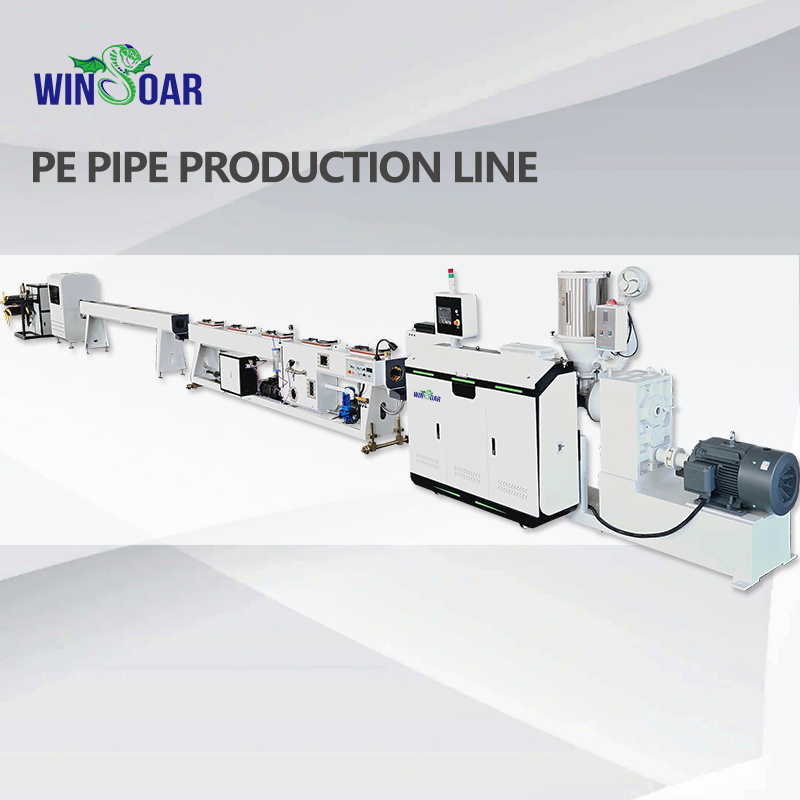
PE pipe output depends on pipe specification, line speed, cooling and downstream matching.
PE pipe output is discussed in two different ways: material throughput, usually expressed in kilograms per hour or kg/h, and finished pipe output, usually expressed in metres per minute, metres per hour or the number of pipes cut per hour.
These figures are related but not interchangeable. A small thin-wall pipe may run at a high line speed while using little material per metre. A large SDR-rated HDPE pipe may use much more material per metre and require a slower, more stable line speed.
When comparing supplier quotations, ask whether the stated capacity refers to the extruder, the complete line or stable finished-pipe production.
Pipe diameter affects die size, melt volume, cooling demand, haul-off force and handling. Small-diameter lines may use a coiler and can be configured for high-speed or multi-size production. Large-diameter HDPE lines need stronger downstream equipment and more cooling space.
The same outside diameter can be produced with different wall thicknesses. A thick-wall pressure pipe uses more material per metre and normally needs more cooling time. SDR, pipe standard and pressure class should be provided before a supplier estimates kg/h.
PE, HDPE, PE100, PE80 and recycled-content formulations can have different processing behaviour. Material grade, melt temperature, moisture control, additives and feeding stability affect motor load, melt pressure and stable extrusion output.
The single screw extruder determines the available plasticizing capacity, but the extruder nameplate maximum is not automatically the finished pipe line output. Screw design, L/D ratio, motor power, gearbox strength, temperature control and feeding consistency all affect sustained production.
The die head, mandrel, calibration sleeve and vacuum calibration tank must match the target diameter and wall thickness. Poor matching can cause unstable wall thickness, ovality, melt fracture or frequent speed reduction, even when the extruder has spare capacity.
Cooling is often the practical limit for larger PE pipes. The pipe must be sufficiently stable before the haul-off, cutter and stacker handle it. Longer vacuum calibration and spray cooling sections may be required for thick-wall or large-diameter HDPE pipe production.
The haul-off must synchronize with extrusion speed without slipping or deforming the pipe. The cutter must maintain length accuracy at the selected speed. Small flexible pipe may use a coiler, while medium and large straight pipe normally needs a stacker, turnover rack or other receiving system.
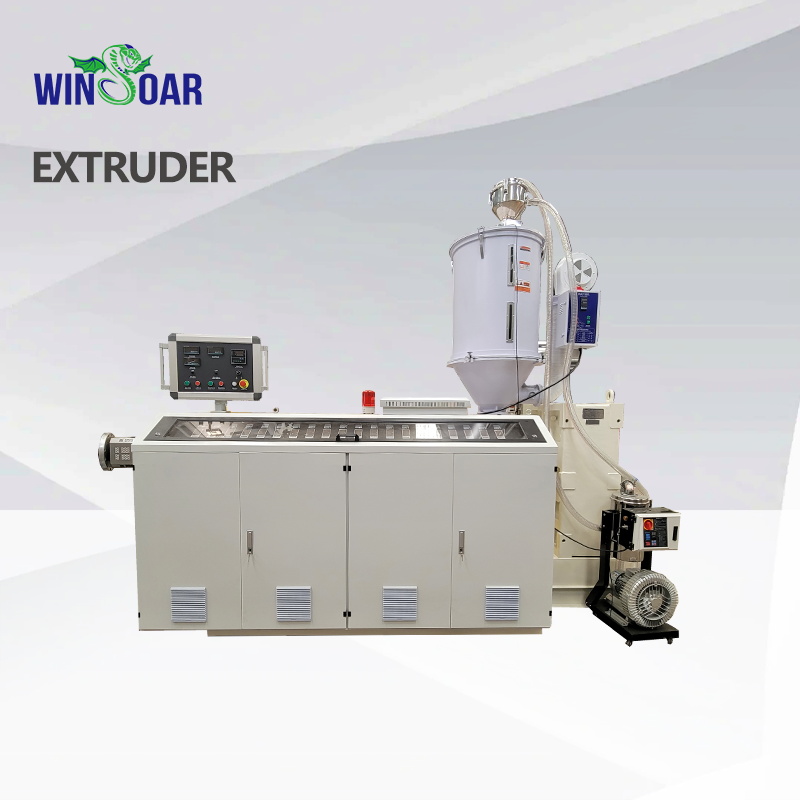
Diameter, wall thickness and downstream equipment must be matched when planning capacity.
The following matrix is a planning guide, not a guaranteed output table. A final capacity proposal should be based on the actual pipe specification and the complete line configuration.
Pipe range | Typical production focus | Main capacity considerations | Related Winsoar page |
|---|---|---|---|
16-63mm | Small PE or HDPE pipe, irrigation pipe, cable conduit and coiled pipe | Extruder stability, die changes, color marking, chipless cutting and coiler speed | |
20-110mm | Small water pipe, gas pipe, irrigation pipe and coiled PE pipe | Single screw output, cooling stability, haul-off synchronization and coiler selection | |
75-250mm | Medium-diameter straight PE pipe for water, drainage and cable duct projects | Wall thickness, cooling length, traction force, cutting accuracy and stacker handling | |
200-400mm | Larger water supply, gas distribution, drainage and industrial pipe | Pipe weight per metre, long cooling sections, heavy-duty haul-off and stable cutting | |
315-800mm | Large-diameter municipal, industrial and pressure-pipe projects | High material throughput, large cooling capacity, strong downstream equipment and workshop layout |
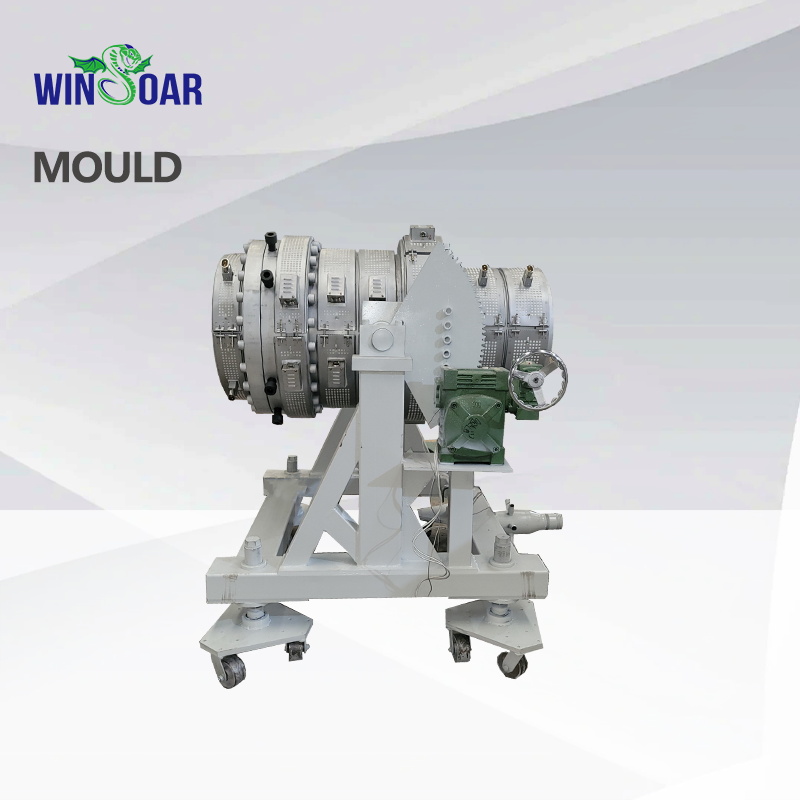
Large-diameter HDPE production needs coordinated cooling, traction, cutting and handling.
Start with the pipe weight per metre and the intended line speed: kg/h = kg/m x m/min x 60.
For example, if a specific pipe design weighs 0.50 kg per metre and the stable line speed is 15 m/min, the preliminary estimate is 0.50 x 15 x 60 = 450 kg/h. This is an engineering estimate for discussion. The real result may be lower if cooling, haul-off, cutting, coiling, stacking or inspection becomes the bottleneck.
For quotation preparation, separate the target material throughput, line speed, finished length or coil weight, diameter range and downstream requirements.
An extruder may be described with a maximum throughput, but a complete PE pipe extrusion line has several linked stages. If the die head is not matched to the screw, if the cooling tank is too short, or if the haul-off cannot maintain traction, the line must run below the extruder's theoretical limit.
For large-diameter projects, an existing Winsoar configuration record includes an 850-1300 kg/h reference range for selected extruder and pipe-line parameters. This is a project reference, not a universal guarantee for every 315-800mm product or material formula. The quotation should state the tested diameter, wall thickness, resin grade, line speed and quality target.
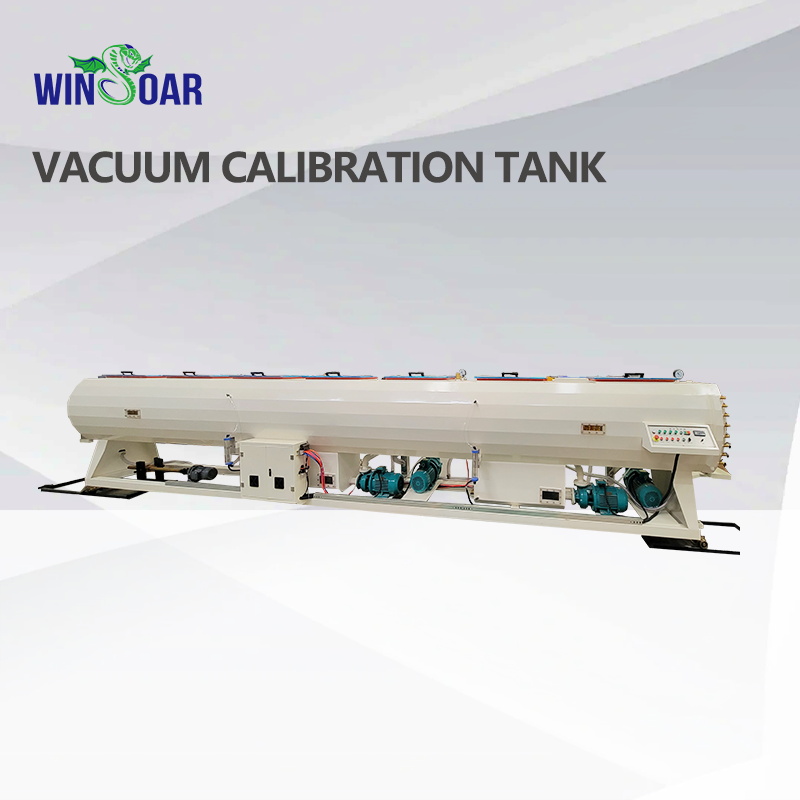
The complete PE line, not the extruder alone, determines stable finished-pipe output.
Water supply pipe projects normally prioritize dimensional stability, pressure-pipe standards, wall thickness control and long-term operating reliability. The capacity estimate should identify the target outside diameter, SDR or pressure class and PE grade.
Gas pipe production requires careful control of material grade, wall thickness, surface quality and traceability. The line should be evaluated by stable finished pipe output, not only by the extruder motor size.
Irrigation projects may involve small diameters, coiling and frequent size changes. Coiler speed, marking, automatic changeover and stable thin-wall calibration can be more important than maximum kg/h.
Drainage and cable conduit projects may use different wall thicknesses and handling methods. Specify whether the finished pipe is supplied straight, coiled, cut to fixed lengths or prepared for another downstream operation.
Buyer information | Why it matters |
|---|---|
Outside diameter range | Determines die, calibration sleeve, cooling and haul-off size |
Wall thickness or SDR | Determines pipe weight per metre and cooling demand |
PE grade and formulation | Affects plasticizing, melt pressure and motor load |
Pipe application and target kg/h | Confirms quality requirements and extruder sizing |
Cut length or coil requirement | Determines receiving and packing equipment |
Workshop dimensions and utilities | Determines cooling length, layout, voltage and installation planning |
There is no universal number. Output depends on diameter, SDR, wall thickness, resin grade, extruder, die, cooling, haul-off, cutter and receiving equipment. A supplier should quote a tested or estimated range for the exact pipe specification.
Both units are useful. kg/h describes material throughput, while m/min describes line speed. The pipe weight per metre connects the two figures.
Yes. A line can cover a diameter range by changing dies, calibration sleeves and settings, but practical capacity depends on the extruder and downstream equipment selected for the most demanding size.
Send the diameter range, wall thickness or SDR, PE grade, application, target kg/h or m/min, cut length or coil requirement, marking requirement, voltage and workshop dimensions.
PE pipe production line output is a system result, not only an extruder specification. Use pipe weight per metre and line speed for a preliminary kg/h estimate, then confirm the die, vacuum calibration, cooling, haul-off, cutter, coiler or stacker configuration against the target PE or HDPE pipe application.
For a project quotation, send Winsoar the target diameter, SDR or wall thickness, material grade, application and output requirement. The recommended line should be sized for stable finished-pipe quality and practical workshop operation.